
Introduction
For safety shoes, microfiber leather must do more than look durable—it has to resist constant rubbing, flexing, and sudden stress without failing at critical points such as the toe box, vamp, and eyelet areas. Abrasion and tear resistance testing helps verify whether the material can maintain surface integrity, structural strength, and service life under demanding workplace conditions. This article explains why these tests matter, what failure patterns they are designed to detect, and how the results guide material selection, product development, and compliance decisions for shoe microfiber leather used in protective footwear.
Why Abrasion and Tear Resistance Matter for Shoe Microfiber Leather
Safety footwear operates in high-stress environments where upper materials are subjected to continuous mechanical degradation. Microfiber synthetic leather, engineered from polyamide microfibers and polyurethane resins, has become the standard for modern safety shoes due to its uniformity and structural stability. However, verifying the structural integrity of this material through rigorous testing is essential to ensure compliance with occupational safety standards.
Wear Failure Patterns in Footwear
Mechanical degradation in occupational footwear manifests through specific failure modes, predominantly localized at high-stress zones. Toe boxes frequently experience severe friction against concrete or steel, leading to surface scuffing and eventual polyurethane (PU) coating delamination. Similarly, the vamp undergoes continuous dynamic flexion, which can propagate micro-tears in the substrate. Field data indicates that safety shoes worn in heavy industrial applications endure an average of 12,000 to 15,000 flex cycles daily, necessitating upper materials that can withstand prolonged friction and dynamic tension without catastrophic failure.
Commercial Pressures Driving Test Validation
Footwear manufacturers face intense commercial pressure to minimize warranty claims and uphold brand reputation in the competitive occupational safety market. Premature material failure directly correlates with elevated return rates; industry benchmarks suggest that field failure rates exceeding 1.2% can severely erode profit margins. Implementing comprehensive abrasion and tear resistance validation protocols mitigates these financial risks. By ensuring that microfiber leather meets stringent durability thresholds before mass production, manufacturers can avoid costly recalls and maintain compliance with international safety certifications.
Key Performance Metrics and Test Methods
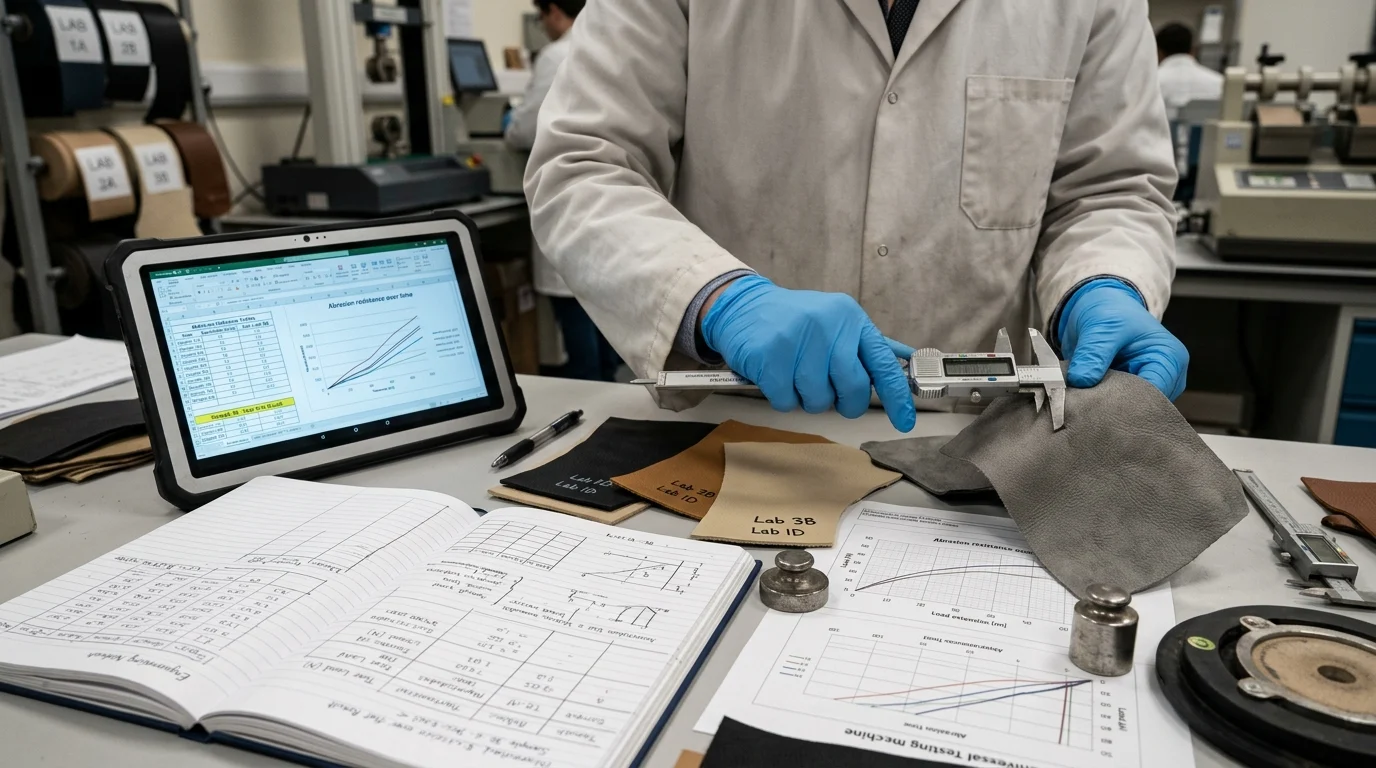
Quantifying the durability of shoe microfiber leather requires a standardized approach to performance metrics. Regulatory frameworks, such as EN ISO 20345 for safety footwear, dictate the minimum mechanical properties required for occupational use. Evaluating these parameters ensures that the synthetic substrate and its protective coating perform cohesively under mechanical stress.
Abrasion, Tear, Flex, and Coating Performance
The primary metrics for safety shoe uppers encompass abrasion resistance, tear strength, flex endurance, and coating adhesion. High-performance microfiber leather is typically required to withstand over 51,200 cycles on the Martindale abrasion apparatus without structural breakdown. Tear strength, critical for preventing puncture propagation, must often exceed 120 N (Newtons) when tested via the Baumann tear method. Additionally, the material must endure dynamic flexion, with premium grades achieving 100,000 flex cycles at ambient temperatures and up to 30,000 cycles at -20°C without visible surface cracking.
Laboratory Methods and Comparison Criteria
Laboratory validation relies on established international standards to ensure reproducibility. The following table outlines the foundational test methods and their typical acceptable thresholds for safety footwear microfiber leather:
| Performance Metric | Standard Test Method | Minimum Acceptable Threshold |
|---|---|---|
| Tear Strength | ISO 3377-2 (Double Edge) | ≥ 120 N |
| Abrasion Resistance | ISO 20344 / Martindale | Dry: 51,200 cycles (No holes) |
| Flex Resistance | ISO 5402 (Bally Flex) | ≥ 100,000 cycles (Dry) |
| Peel Strength (Adhesion) | ISO 11644 | ≥ 2.5 N/mm |
Engineers utilize these standardized protocols to benchmark incoming batches against approved reference samples. Discrepancies in the testing apparatus calibration or environmental conditioning (standardized at 23°C and 50% relative humidity) can skew results, making strict adherence to laboratory procedures paramount.
How Material Design Affects Durability
The mechanical resilience of microfiber leather is intrinsically linked to its microstructural engineering. Unlike natural hides, which possess inherent biological variations, synthetic microfiber is a precision-manufactured composite. By manipulating the base non-woven matrix and the subsequent polyurethane impregnation, manufacturers can explicitly tailor the abrasion and tear resistance to meet specific occupational hazards.
Fiber Structure, Density, Resin, and Surface Effects
The foundation of microfiber leather is typically an ‘island-in-the-sea’ polyamide fiber structure, which is needle-punched into a dense three-dimensional non-woven matrix. The density of this matrix, generally ranging from 400 to 650 grams per square meter (gsm) for safety footwear, directly dictates the base tear strength. Following matrix formation, the material undergoes polyurethane (PU) resin impregnation and coagulation. The ratio of solid PU to microfiber, alongside the chemical formulation of the surface coating, governs the final abrasion resistance. High-density fiber packing combined with cross-linked aliphatic PU topcoats yields maximum defense against scuffing and delamination.
Trade-Offs Between Softness, Weight, and Strength
Engineers must navigate complex trade-offs between material softness, overall weight, and mechanical strength. Increasing the thickness of the microfiber substrate—commonly specified between 1.8 mm and 2.2 mm for heavy-duty safety shoes—enhances tear resistance but proportionally increases shoe weight and reduces flexibility. Conversely, softer formulations utilize higher ratios of microporous PU, which improves wearer comfort and flex endurance but may compromise ultimate tensile and abrasive strength. Optimizing the resin formulation allows formulators to achieve a balance, delivering an upper material that resists tear propagation without exceeding optimal weight thresholds.
Comparing Microfiber Leather with Alternative Materials
When evaluating upper materials for safety footwear, microfiber leather offers distinct structural advantages over traditional alternatives. The following table contrasts key durability characteristics across common upper materials:
| Material Type | Tear Resistance Variability | Abrasion Resistance | Weight (at 1.8mm thickness) | Lot-to-Lot Consistency |
|---|---|---|---|---|
| Microfiber Leather | Highly uniform (Isotropic) | Excellent (Customizable PU) | ~800 – 950 g/m² | High |
| Genuine Bovine Leather | Variable (Directional) | Good to Excellent | ~1,200 – 1,400 g/m² | Low to Moderate |
| Standard PU Synthetic | Low (Woven backing) | Moderate | ~600 – 800 g/m² | High |
Microfiber’s isotropic structure ensures that tear strength remains consistent regardless of the cutting direction, minimizing material waste and reinforcing the shoe’s structural integrity in high-stress zones.
How to Specify, Test, and Approve Materials
Transitioning a high-performance microfiber leather from the development phase to mass production requires rigorous specification and approval protocols. Footwear manufacturers must establish an uncompromising quality assurance framework to verify that commercial batches consistently meet the exact tolerances defined during the initial engineering phase.
Incoming Quality Qualification Steps
Incoming quality qualification begins with statistically significant sampling. A standard industry protocol dictates extracting one 1-meter test specimen for every 1,000 linear meters of incoming material. These samples undergo immediate verification of physical properties, focusing on gauge thickness (e.g., 2.0 mm ± 0.1 mm), peeling strength, and basic tear resistance. If a sample fails to meet the 120 N tear threshold or exhibits premature coating separation during rapid flex testing, the entire lot is quarantined. Advanced qualification may also involve Fourier-transform infrared spectroscopy (FTIR) to ensure the chemical composition of the PU resin matches the approved master sample, preventing unapproved cost-reduction alterations by the supplier.
Procurement and Technical Approval Criteria
Technical approval relies on highly detailed material specification sheets (tech packs). Procurement criteria must explicitly state not only the minimum performance thresholds but also the exact test standards (e.g., ISO 3377-2) and the required environmental conditioning parameters. Approval is typically a multi-stage process: laboratory approval of A4-sized swatches, pilot run approval involving 50 to 100 pairs of fully constructed shoes subjected to field wear trials, and finally, bulk production approval. Establishing strict Minimum Order Quantities (MOQs)—often 500 to 1,000 meters per colorway—ensures that the supplier can maintain continuous, stable production runs, thereby reducing the risk of lot-to-lot mechanical variance.
Selection Framework and Sourcing Guidance
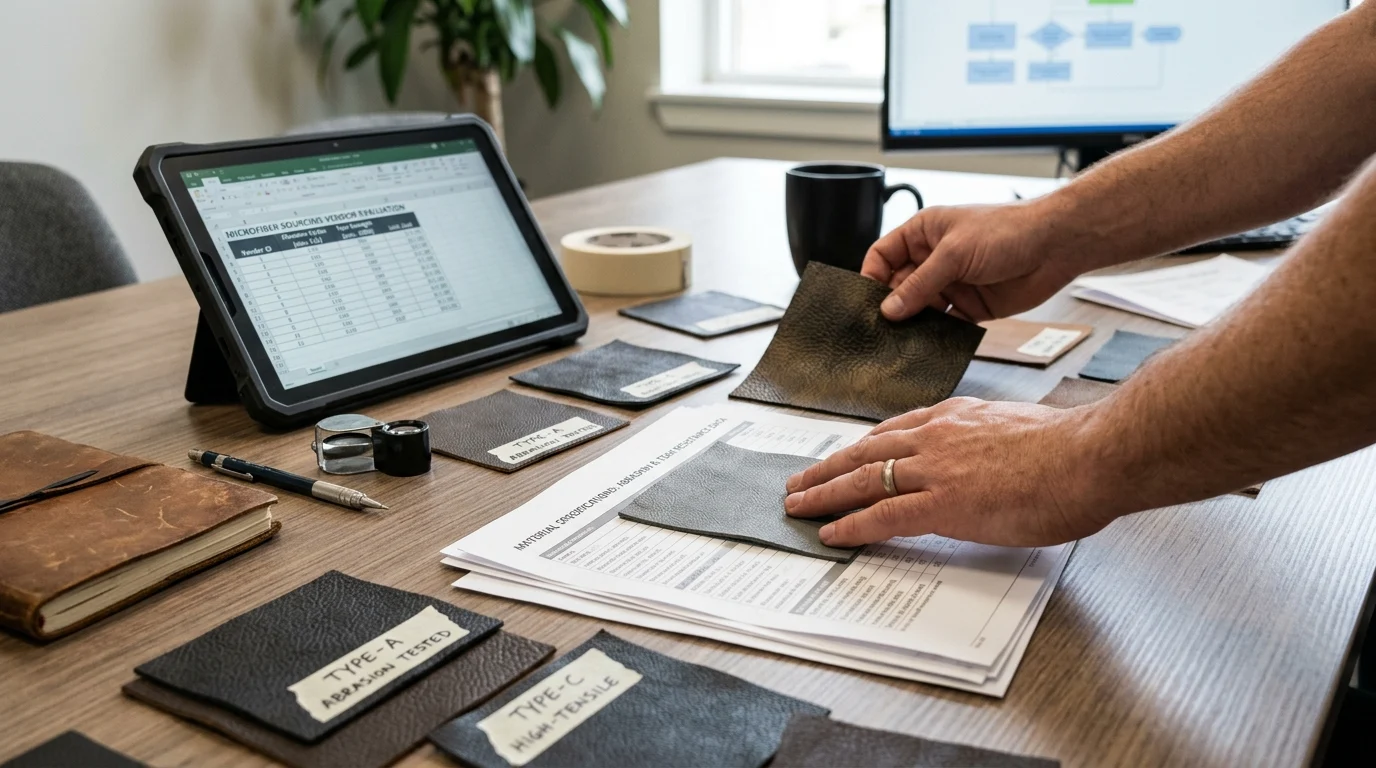
Selecting the optimal microfiber leather requires aligning the material’s mechanical capabilities with the specific hazard profile of the intended footwear application. A strategic sourcing framework prevents both costly over-engineering and dangerous under-specification, ensuring the final product meets both safety standards and economic targets.
Matching Performance Targets to Footwear Applications
Performance targets must be calibrated to the specific safety classification of the footwear. For light-duty indoor applications (e.g., S1 safety class footwear used in warehousing), a 1.4 mm to 1.6 mm microfiber with standard abrasion resistance (30,000 Martindale cycles) is typically sufficient. However, heavy-duty construction or petrochemical environments (S3 or S7 safety classes) demand highly engineered substrates. These applications require a minimum thickness of 1.8 mm to 2.2 mm, enhanced hydrolysis resistance to combat chemical degradation, and abrasion resistance exceeding 60,000 cycles. By mapping the material specification directly to the occupational hazard, sourcing teams can optimize the cost-to-performance ratio.
Specification Practices That Reduce Field Failures
To systematically reduce field failures, manufacturers must implement precise specification practices embedded within their supplier contracts. Ambiguity in technical documentation is a primary cause of material failure. Specifications should define strict tolerance bands rather than single-value targets; for instance, stipulating a tear strength of ‘130 N ± 10 N’ rather than simply ‘>120 N’. Furthermore, mandating bi-annual third-party testing at accredited laboratories provides an independent audit of the supplier’s internal quality control data. By combining tightly defined performance bands with independent verification, footwear brands can secure a reliable supply chain of highly durable microfiber leather, safeguarding both the end-user and the corporate bottom line.
Key Takeaways
- The most important conclusions and rationale for shoe microfiber leather
- Specs, compliance, and risk checks worth validating before you commit
- Practical next steps and caveats readers can apply immediately
Frequently Asked Questions
What abrasion level is typically required for safety shoe microfiber leather?
A common benchmark is 51,200 Martindale cycles with no holes under ISO 20344 conditions, suitable for many safety footwear programs.
Which tear strength target should buyers check for?
For safety shoe uppers, a practical target is at least 120 N using ISO 3377-2, helping prevent small cuts from spreading in service.
Why can lab results vary between suppliers?
Differences in sample conditioning, machine calibration, and test settings can change results. Ask for reports run at 23°C and 50% RH with the exact standard listed.
How does material design affect abrasion and tear resistance?
Higher base density, well-impregnated microfiber structure, and durable PU topcoats usually improve scuff resistance, tear strength, and coating adhesion.
Can HAOHAO support custom safety shoe microfiber development?
Yes. With 3 factories, 20+ years of experience, and scalable R&D-to-production support, HAOHAO can help match test targets, surface feel, and supply volume.