
Introduction
Suede microfiber leather has become a practical favorite in fashion and footwear because it combines the soft, matte look of suede with the consistency of an engineered material. Unlike natural hides, it offers uniform texture, predictable supply, and more efficient cutting in large-scale production, while also meeting growing demands for durability and lower environmental impact. This article explains what suede microfiber leather is, why brands and manufacturers are adopting it, and how its appearance, performance, and production advantages make it especially well suited to modern shoes, bags, and apparel.
Why Is Suede Microfiber Leather Gaining Importance in Fashion
The textile and apparel industries are undergoing a profound transformation as brands seek materials that balance high-end aesthetics with scalable manufacturing. Suede microfiber leather has emerged as a premier alternative to genuine animal suede, moving beyond its origins as a mere imitation to become a highly engineered performance textile. Its rising prominence is directly tied to its ability to solve critical supply chain bottlenecks, offering predictable quality and consistent availability that natural animal hides cannot match.
As global fashion houses and footwear manufacturers scale their operations, the demand for standardized, high-yield materials has intensified. Suede microfiber leather provides a uniform roll-based format that eliminates the irregular shapes, scars, and natural defects associated with traditional leather, fundamentally optimizing the cutting and assembly phases of production.
How does it align with current performance and sustainability needs?
Modern apparel and footwear markets operate under strict environmental and performance mandates. Suede microfiber leather aligns seamlessly with these requirements by offering a synthetic alternative that significantly reduces the ecological footprint associated with animal agriculture and heavy-metal tanning. Manufacturing high-quality microfiber suede typically requires up to 40% less water than traditional chrome-tanned leather processes.
On the performance front, the material is engineered to withstand extreme wear while maintaining a soft, luxurious hand feel. It resists the stiffening and cracking that often plague natural suede when exposed to moisture, making it a highly functional choice for all-weather footwear and durable fashion accessories.
Which market shifts are driving adoption?
Several macro-economic and social shifts are accelerating the adoption of suede microfiber leather. The global vegan leather market is projected to expand at a compound annual growth rate (CAGR) of approximately 7.5% through the end of the decade, driven by evolving consumer ethics and stringent regional legislation regarding animal welfare and chemical usage.
Furthermore, supply chain volatility in the raw hide market has forced brands to seek price-stable alternatives. Because suede microfiber leather relies on synthetic polymers, its pricing is insulated from the agricultural fluctuations that cause unpredictable spikes in genuine leather costs. This predictability allows brands to lock in long-term sourcing contracts and maintain stable retail pricing.
What Is Suede Microfiber Leather and How Is It Specified
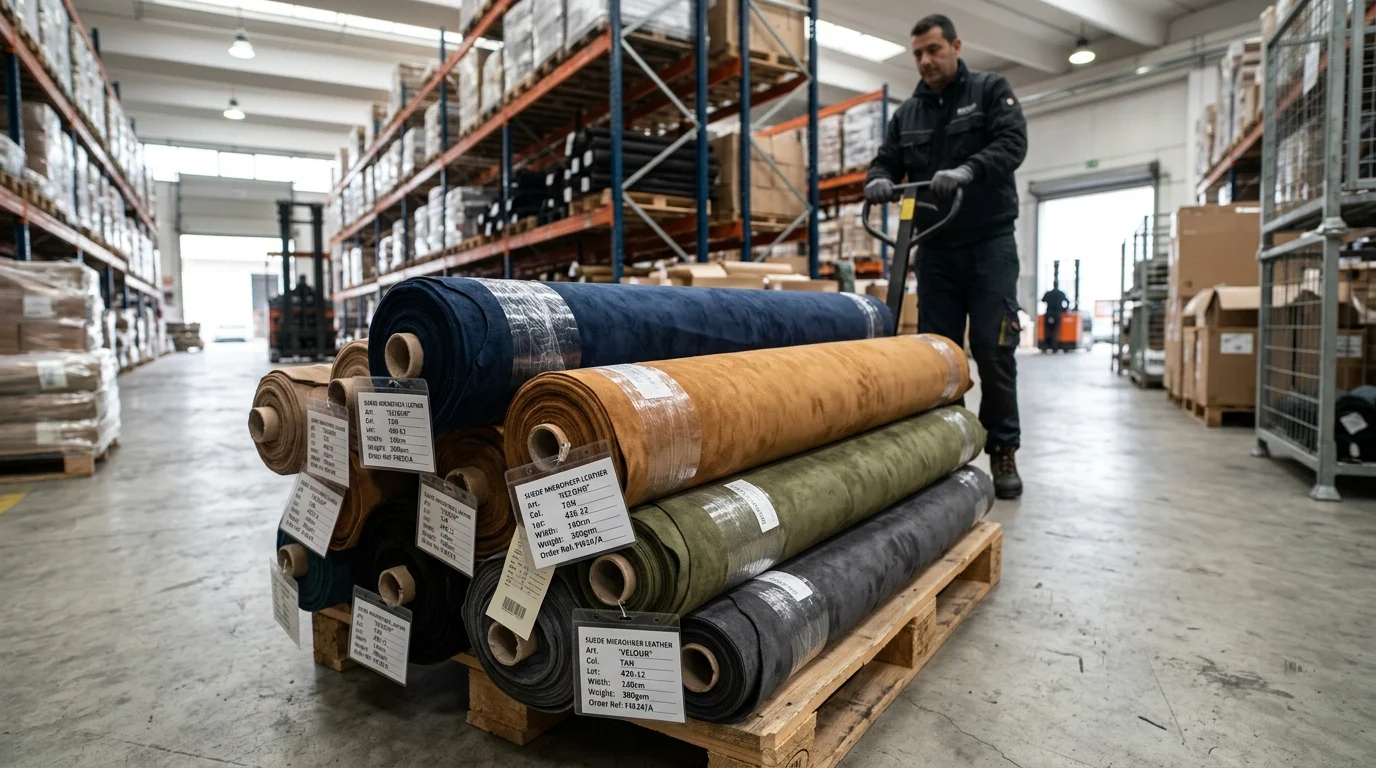
Suede microfiber leather is an advanced synthetic textile designed to replicate the three-dimensional collagen fiber structure of natural leather. Unlike cheaper polyurethane (PU) or polyvinyl chloride (PVC) synthetics that simply coat a woven fabric, microfiber leather is built from the ground up using non-woven fiber matrices, resulting in superior structural integrity and a genuine suede-like nap.
How is it constructed and how does it differ from traditional suede?
The construction of suede microfiber leather relies heavily on “sea-island” fiber spinning technology. This process creates ultra-fine polyamide (nylon) fibers—often measuring between 0.01 and 0.001 denier—which are bundled together and impregnated with high-grade polyurethane resins. Once the “sea” component is dissolved, the remaining “island” fibers form a dense, porous network.
This intricate matrix is then buffed and sanded to raise a soft, uniform nap. Traditional suede is created by sanding the underside of an animal hide, which inherently results in varying thicknesses and weak spots. In contrast, the engineered nature of microfiber ensures consistent density and tensile strength across every square meter of the material.
Which technical specifications should buyers compare?
Procurement teams must evaluate several critical technical specifications to ensure the material meets end-product requirements. Thickness is a primary variable, typically ranging from 0.5mm for lightweight apparel to 2.0mm for heavy-duty footwear. Tear strength and peel strength are equally vital; high-grade suede microfiber should exhibit a tear strength exceeding 40 Newtons (N) to prevent failure at stitching seams.
Colorfastness is another essential metric. Because the fibers are synthetically dyed, buyers should demand a colorfastness rating of at least Grade 4 (on a 1-to-5 scale) for both wet and dry rubbing, ensuring the vibrant dyes do not bleed onto adjacent materials or the wearer’s skin.
What key comparison points distinguish suede microfiber leather from alternatives?
Distinguishing suede microfiber leather from its alternatives requires a clear understanding of weight, durability, and yield. The table below outlines the core differences between genuine suede, suede microfiber, and standard PU suede.
| Feature | Genuine Suede | Suede Microfiber | Standard PU Suede |
|---|---|---|---|
| Weight | 600-800 g/m² | 400-500 g/m² | 300-400 g/m² |
| Tear Strength | High | Very High (>40N) | Low to Medium |
| Breathability | High | Moderate-High | Low |
| Thickness | Inconsistent | Uniform (0.5-2.0mm) | Uniform |
| Usable Yield | ~70% | 100% | 100% |
This comparison highlights why microfiber is the optimal middle ground: it captures the premium feel and strength of genuine suede while offering the 100% usable yield of standard synthetics.
Why Do Fashion and Footwear Brands Prefer Suede Microfiber Leather
Fashion and footwear brands are increasingly standardizing their product lines around suede microfiber leather due to its unmatched consistency and manufacturing efficiency. Transitioning to this material allows brands to scale production rapidly without the bottleneck of hand-grading and sorting animal hides.
How does it perform in aesthetics, abrasion resistance, and care?
Aesthetically, high-quality microfiber suede is virtually indistinguishable from premium calf suede, offering a rich, multi-directional nap that writes well when brushed. In terms of durability, it excels in abrasion resistance. Standard footwear-grade microfiber routinely survives over 50,000 rubs on the Martindale abrasion test, with high-performance variants exceeding 80,000 rubs.
Care and maintenance present another significant advantage. Natural suede is notoriously sensitive to water, oil, and dirt, often requiring specialized chemical cleaners. Suede microfiber leather, by contrast, is inherently water-resistant and can often be machine washed or easily spot-cleaned with mild soap, drastically improving the consumer experience and extending the product’s lifecycle.
What are the main trade-offs?
Despite its numerous benefits, suede microfiber leather does present specific trade-offs. While breathability is vastly superior to standard PU leathers, it still falls slightly short of the natural vapor permeability found in unlined animal hides. In extremely high-heat applications, this can lead to minor moisture retention.
Additionally, cost is a factor when comparing synthetics. Suede microfiber is a premium engineered textile; it typically costs between $6.00 and $14.00 per linear meter. This places it significantly higher than standard PU synthetics ($3.00 to $5.00 per meter), meaning brands must justify the premium through enhanced durability and brand positioning.
Which product categories benefit most?
Footwear is the dominant beneficiary of this material, particularly in the sneaker and outdoor boot categories. Athletic brands utilize 1.2mm to 1.8mm thickness profiles to reinforce toe boxes and heel counters without adding excessive weight. The material’s high tear strength accommodates the aggressive stitching patterns required in modern sneaker design.
Beyond footwear, the material is highly favored in the luxury handbag and accessory markets. Designers appreciate the structural stability it provides, allowing bags to maintain their shape over time. In the apparel sector, lightweight variants (0.5mm to 0.8mm) are used for tailored jackets and trench coats, offering a draping quality that mimics ultra-soft lambskin suede.
How Should Companies Evaluate Sourcing and Manufacturing Risks
Transitioning to suede microfiber leather requires rigorous supplier vetting. Because the market is flooded with varying grades of synthetic leather, procurement teams must implement strict quality control measures to ensure they are sourcing true non-woven microfiber rather than inferior coated fabrics.
Which supplier qualification criteria and testing protocols matter most?
Supplier qualification should begin with international compliance certifications. Facilities should hold ISO 9001 for quality management and ISO 14001 for environmental standards. For brands selling into the European market, REACH compliance is non-negotiable.
A critical testing protocol involves monitoring Dimethylformamide (DMF) levels. DMF is a solvent traditionally used in polyurethane production. Strict environmental and health regulations now require DMF levels in the finished textile to be below 30 parts per million (ppm), with many leading brands demanding entirely solvent-free (water-borne PU) microfiber options.
How do MOQ, lead time, backing options, and finishes affect sourcing?
Logistical parameters heavily influence sourcing strategies. Minimum Order Quantities (MOQs) for custom-dyed suede microfiber typically range from 300 to 1,000 meters per colorway. Lead times generally span 15 to 30 days, depending on the complexity of the fiber spinning and dyeing processes.
Backing options and finishes also dictate manufacturing timelines. Suppliers can apply various functional finishes during production, such as anti-microbial treatments, flame retardancy, or durable water repellent (DWR) coatings. Specifying these treatments upfront is essential, as post-production application is often less durable and costlier.
What practical steps help brands choose the right supplier?
To mitigate risks, brands should execute a phased sampling strategy. This begins by requesting A4-sized swatches to evaluate hand-feel and nap density. Following swatch approval, brands should order a 50-meter sample roll to conduct in-house cutting, stitching, and lasting trials.
Batch-to-batch color consistency is a common pitfall in synthetic textiles. Procurement teams should contractually obligate suppliers to maintain a Delta E (ΔE) color variance of less than 1.0 between production batches, ensuring that a shoe manufactured in January matches a shoe manufactured in July perfectly.
How Can Decision-Makers Determine Whether It Is the Right Material
Determining whether suede microfiber leather is the correct material for a specific product line requires a holistic analysis of costs, performance targets, and manufacturing yields. Decision-makers must move beyond simple per-meter price comparisons and evaluate the total cost of ownership.
Which cost-performance-use-case framework supports selection?
A robust cost-performance framework aligns the material’s specifications with the end-product’s use case. Over-engineering a fast-fashion garment with heavy-duty footwear microfiber destroys profit margins, while under-specifying a hiking boot leads to premature failure.
| Application | Recommended Thickness | Target Abrasion (Martindale) | Estimated Cost Band (USD/m) |
|---|---|---|---|
| High-Performance Sneakers | 1.4mm – 1.8mm | >80,000 rubs | $8.00 – $14.00 |
| Fashion Handbags | 0.8mm – 1.2mm | >40,000 rubs | $6.00 – $10.00 |
| Apparel / Jackets | 0.5mm – 0.8mm | >25,000 rubs | $5.00 – $8.00 |
By utilizing this framework, product developers can pinpoint the exact grade of microfiber required, optimizing both factory costs and retail price points.
What should a final decision checklist include?
The final decision checklist must include a strict yield calculation. Because genuine animal hides feature irregular edges, scars, and varying grain directions, their usable yield rarely exceeds 70%. In contrast, suede microfiber leather is delivered on continuous rolls, guaranteeing a 100% usable yield.
Executives must also verify that the chosen material aligns with the brand’s marketing ethos. If the brand is positioning itself as sustainable or vegan, the procurement team must secure the necessary documentation (e.g., Global Recycled Standard certifications for recycled nylon variants) from the supplier to substantiate these claims and avoid greenwashing accusations.
Key Takeaways
- The most important conclusions and rationale for suede microfiber leather
- Specs, compliance, and risk checks worth validating before you commit
- Practical next steps and caveats readers can apply immediately
Frequently Asked Questions
What makes suede microfiber leather popular for fashion and footwear?
It combines a soft suede look with consistent quality, easier cutting yield, and better resistance to moisture and cracking than natural suede.
How is suede microfiber leather different from standard PU suede?
It uses a non-woven microfiber structure, not just a surface coating, so it offers better strength, durability, and a more natural suede-like nap.
Which specs should buyers check before ordering suede microfiber leather?
Focus on thickness, tear strength above 40N, peel strength, and colorfastness of at least Grade 4 for wet and dry rubbing.
Why do footwear brands choose suede microfiber leather for production?
It comes in uniform rolls, reduces waste from irregular hide shapes, supports stable pricing, and performs well in all-weather shoe applications.
Can hh-mf.com supply suede microfiber leather for different product uses?
Yes, buyers can request suitable thickness, texture, and performance options for apparel, footwear, bags, and other fashion applications.