
Introduction
Choosing between silicone leather and PU leather affects more than appearance: it shapes durability, cleaning performance, lifecycle cost, and suitability for demanding commercial settings. While both materials are used as synthetic alternatives to traditional upholstery, they differ significantly in chemical structure, resistance to wear, and long-term maintenance behavior. This comparison explains where silicone leather stands apart from PU leather, especially in environments such as healthcare, hospitality, and public seating where disinfection, abrasion, and warranty risk matter. By the end, readers will have a clearer basis for evaluating performance trade-offs, expected service life, and which material better fits specific commercial requirements.
Why silicone leather vs PU leather matters in commercial applications
Selecting the appropriate synthetic upholstery material directly impacts product longevity, warranty liabilities, and user satisfaction. As commercial sectors shift away from traditional polyvinyl chloride (PVC) due to environmental and health concerns, the debate between silicone leather and polyurethane (PU) leather has become a focal point for industrial buyers.
Understanding the technical distinctions between these materials is essential for procurement teams aiming to balance unit economics with long-term performance.
Performance expectations
Commercial environments subject upholstery materials to relentless wear and stringent sanitation protocols. In the healthcare and hospitality sectors, materials must routinely withstand harsh chemical disinfectants and mechanical abrasion levels exceeding 100,000 Wyzenbeek double rubs without degrading.
Failure to meet these performance expectations results in premature surface cracking, leading to costly replacements and potential hygiene compliance violations in sterile environments.
Key differences at a glance
The primary divergence between the two materials lies in chemical stability. Standard PU leather offers a highly cost-effective synthetic alternative but is inherently susceptible to hydrolysis, often leading to surface flaking within 3 to 5 years of heavy commercial use.
Conversely, silicone leather features an inorganic polymer backbone that resists chemical breakdown. This fundamental structural advantage extends the functional lifespan of silicone-coated fabrics to 10 to 15 years, even in high-traffic or high-humidity settings.
What silicone leather and PU leather are
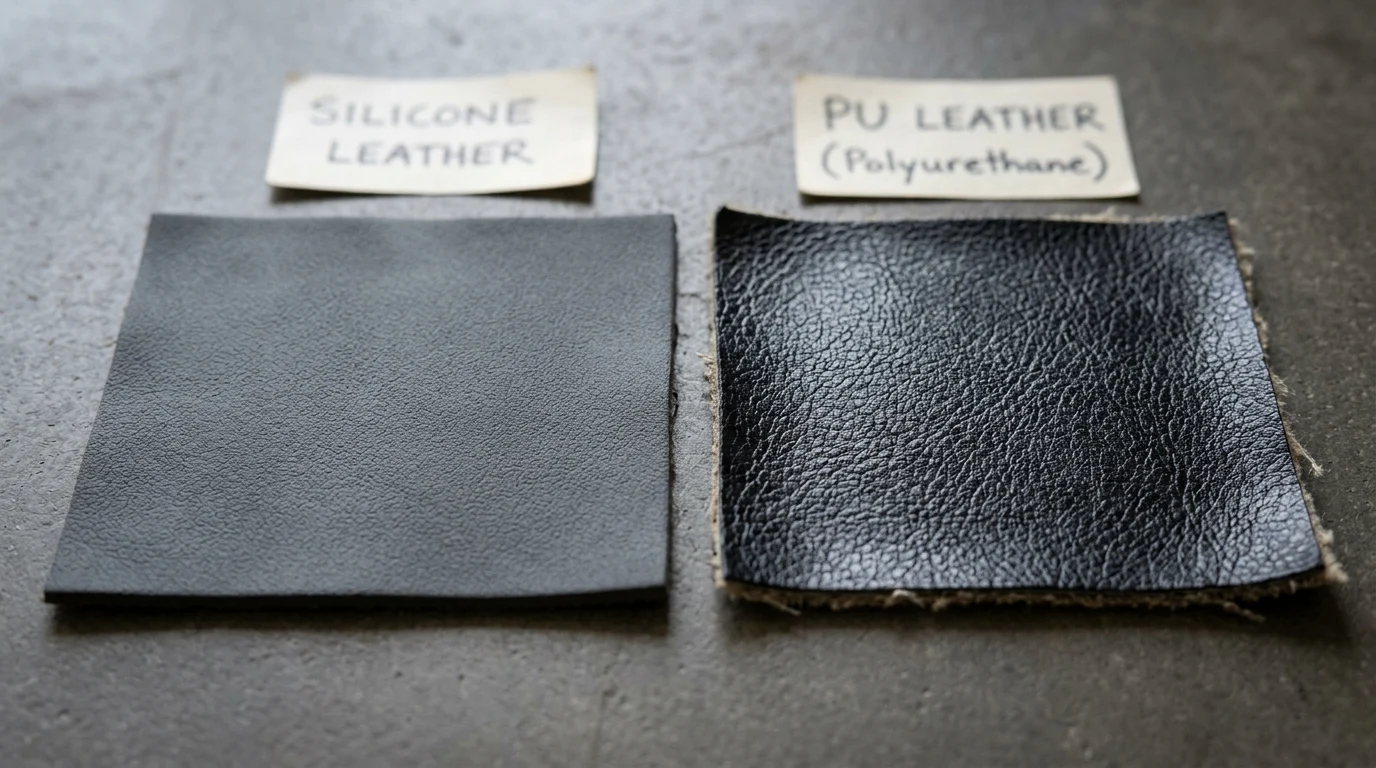
Understanding the performance delta between these two synthetic leathers requires examining their distinct chemical compositions and manufacturing processes. While both are coated fabrics, the active polymers dictate their respective physical limitations and environmental footprints.
Silicone leather construction
Silicone leather is manufactured using a solvent-free casting or calendering process. A layer of 100% silicone polymer is thermally bonded directly to a substrate, typically a polyester or microfiber woven backing.
Because silicone is inherently flexible at a molecular level, the formulation requires zero added plasticizers. This results in a finished material, usually ranging between 0.8mm and 1.2mm in thickness, that emits virtually zero volatile organic compounds (VOCs) over its lifecycle.
PU leather composition
PU leather consists of a polyurethane resin coated over a fabric base. Traditional manufacturing utilizes chemical solvents like dimethylformamide (DMF) to achieve the desired liquid viscosity during production, though water-based PU (WBPU) has gained traction to reduce toxic emissions.
Typically measuring 0.9mm to 1.5mm thick, PU leather utilizes organic polymer chains containing urethane linkages. These specific chemical bonds are inherently vulnerable to breaking apart when exposed to a combination of ambient moisture and elevated temperatures over time.
How silicone leather compares with PU leather
When evaluating silicone leather against PU leather, industrial buyers must carefully weigh physical resilience against aesthetic flexibility and raw material costs. The operational environment of the end product largely dictates which material will yield the best return on investment.
Durability and environmental resistance
Silicone leather drastically outperforms standard PU in environmental resistance. Under ASTM D4329 UV exposure testing, high-grade silicone variants routinely pass 1,000+ hours with zero color fading or surface cracking. PU leather, by contrast, often exhibits noticeable degradation and embrittlement between 200 and 500 hours.
Furthermore, in the ISO 1419 Jungle Test—an accelerated aging process conducted at 70°C and 95% relative humidity—silicone leather withstands over 10 weeks of continuous exposure. Standard PU leather typically fails this exact same hydrolysis test in just 3 to 5 weeks.
Appearance and hand feel
Aesthetically, PU leather is highly versatile, capable of closely mimicking the deep grain patterns, burnishing, and varied gloss levels of natural animal hide. It is the preferred choice when achieving a traditional leather look is paramount.
Silicone leather possesses a distinct, ultra-smooth or slightly grippy tactile profile. It also features remarkably lower thermal conductivity than PU, meaning it remains cooler to the touch in direct sunlight and does not stiffen or crack in freezing temperatures down to -40°C.
Comparison table
The following table summarizes the core comparative metrics between the two materials to assist in rapid procurement evaluations.
| Performance Metric | Silicone Leather | Standard PU Leather |
|---|---|---|
| Polymer Base | 100% Inorganic Silicone | Organic Polyurethane |
| Hydrolysis Resistance | 10+ Weeks (ISO 1419) | 3 – 5 Weeks (ISO 1419) |
| UV Resistance | 1,000+ Hours | 200 – 500 Hours |
| VOC Emissions | Ultra-low to Zero | Moderate (unless WBPU) |
| Thermal Conductivity | Low (Temperature stable) | Moderate (Heats in sun) |
What buyers should check before sourcing
Sourcing synthetic leather at scale requires rigorous quality assurance protocols. Buyers must validate supplier marketing claims through standardized testing and closely monitor supply chain logistics to prevent costly material failures during mass production.
Specifications and test methods
Procurement teams should demand third-party laboratory reports for critical performance metrics before approving any new material supplier. Relying solely on internal factory data increases the risk of premature field failures.
| Test Parameter | Recommended Standard | Minimum Acceptable Result |
|---|---|---|
| Abrasion Resistance | ASTM D4157 (Wyzenbeek) | > 100,000 Double Rubs |
| Hydrolysis (Jungle Test) | ISO 1419 | > 5 Weeks (PU) / > 10 Weeks (Silicone) |
| Stain Resistance | CFFA-147 | Class 4 or 5 (No residual stain) |
| Coating Adhesion | ASTM D751 | > 30 N / 3cm Peel Strength |
Lead times and manufacturing quality
Because silicone leather relies on specialized curing ovens and solvent-free production lines, the global supplier base is narrower compared to the ubiquitous PU leather market. Consequently, minimum order quantities (MOQs) for custom silicone leather colors typically range from 500 to 1,000 linear meters.
Lead times for silicone leather generally span 3 to 5 weeks depending on capacity. During contract negotiations for either material, buyers should strictly mandate a maximum allowable defect rate of under 2% per roll to ensure efficient cutting yields.
Material evaluation steps
Prior to mass production, buyers must execute a structured evaluation sequence. This includes requesting A4-sized production swatches to verify color consistency under standard D65 daylight viewing conditions.
Additionally, physical inspection must verify the backing adhesion strength. If the peel strength falls below the 30 N/3cm threshold, the material is highly susceptible to delamination during the physical stretching required in the upholstery process.
Which material to choose for your use case
The final procurement decision rests on aligning the material’s physical capabilities with the target product’s expected lifecycle, environmental exposure, and retail price point. Neither material is universally superior; rather, each serves distinct market segments.
When silicone leather is the better fit
Silicone leather is the optimal choice for high-liability, extreme-use applications. Marine upholstery, hospital beds, outdoor commercial seating, and mass transit interiors benefit immensely from its chemical inertness, stain resistance, and UV stability.
In these demanding sectors, the higher initial procurement cost—often ranging from $15 to $25 per linear yard—is easily justified by the elimination of warranty claims, reduced maintenance overhead, and a field lifespan exceeding 10 years.
When PU leather is the practical choice
PU leather remains the highly practical, economical choice for standard indoor applications where extreme durability is not the primary driver. Residential dining chairs, fast-fashion apparel, and budget-tier automotive aftermarket accessories are ideal use cases.
With wholesale costs typically sitting between $4 and $10 per yard, PU leather allows manufacturers to maintain aggressive pricing margins while delivering a highly realistic, attractive finish perfectly suited for a standard 3 to 5-year consumer product lifecycle.
Key Takeaways
- The most important conclusions and rationale for silicone leather
- Specs, compliance, and risk checks worth validating before you commit
- Practical next steps and caveats readers can apply immediately
Frequently Asked Questions
What is the main difference between silicone leather and PU leather?
Silicone leather uses an inorganic silicone coating, while PU leather uses polyurethane. This makes silicone leather more resistant to hydrolysis, UV, and chemicals in demanding commercial settings.
Which lasts longer in heavy-use commercial upholstery?
Silicone leather typically lasts 10–15 years in high-traffic or humid environments. Standard PU leather often shows flaking or cracking after 3–5 years of heavy use.
Is silicone leather better for healthcare and hospitality use?
Yes. It handles harsh disinfectants, frequent cleaning, and heavy abrasion better than standard PU, helping reduce premature failure and replacement costs.
Does silicone leather feel different from PU leather?
Yes. Silicone leather usually feels smoother or slightly grippy and stays cooler to the touch. PU leather often better imitates the classic grain and look of natural leather.
How can buyers choose the right synthetic leather for a project?
Choose silicone leather for durability, hygiene, and outdoor or high-humidity performance. Choose PU leather when lower upfront cost and a more traditional leather appearance matter most.