


Choosing an eco-friendly shoe material supplier in China is no longer just a price comparison exercise. Footwear brands now need materials that combine lower environmental impact with measurable performance in tear strength, abrasion resistance, moisture management, and chemical compliance. As microfiber technology advances through rPET bases, bio-based PU systems, and cleaner production processes, the challenge is identifying manufacturers that can scale innovation without sacrificing consistency. This guide explains how to evaluate high-performance microfiber shoe materials, compare technical specifications, verify sustainability claims, and select a Chinese manufacturing partner capable of meeting both market regulations and modern footwear demands.
How to Define the Search for an Eco-Friendly Shoe Material
Sourcing an eco-friendly shoe material supplier in China requires a strategic approach, as the region remains the global hub for synthetic leather manufacturing. With increasing regulatory pressure and consumer demand for sustainable footwear, brands must identify partners capable of delivering high-performance materials without compromising environmental integrity.
Navigating this market requires moving beyond basic supplier directories. Buyers must establish rigorous frameworks to evaluate technological capabilities, ensuring that the chosen manufacturing partner can seamlessly integrate sustainable practices with the exacting mechanical demands of modern shoemaking.
Define high-performance microfiber shoe materials
High-performance microfiber is an engineered non-woven material designed to replicate the microscopic three-dimensional structure of natural leather. It is typically composed of bundled sea-island microfibers—often measuring between 0.001 and 0.01 denier—that are impregnated with high-grade polyurethane (PU) resins. Unlike basic synthetic leathers that merely coat a woven fabric, advanced microfiber offers superior durability, breathability, and significant weight reduction, making it a critical substrate for athletic, safety, and outdoor footwear.
Clarify product, market, and sustainability requirements
Before initiating supplier outreach, procurement teams must establish strict baselines for their footwear lines. This involves determining the acceptable ratio of sustainable inputs, such as demanding a minimum of 30% USDA-certified bio-based polyurethane or stipulating the use of 100% recycled polyethylene terephthalate (rPET) in the base matrix. Buyers must also align these material specifications with target market regulations, ensuring the end product will clear stringent frameworks like the European Union’s REACH directive or California’s Proposition 65 right from the development phase.
Key Material Specifications to Compare
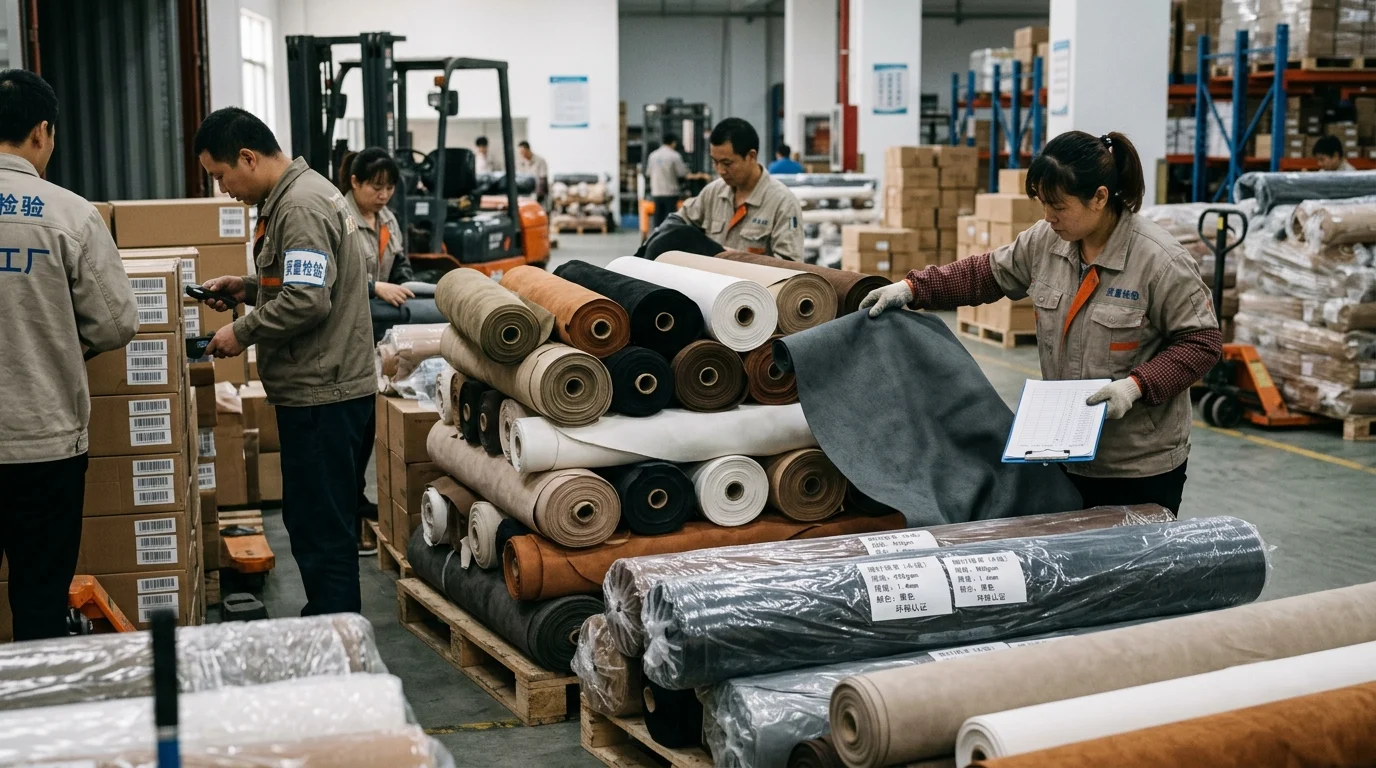
Evaluating a Chinese manufacturer’s technical capabilities requires moving beyond visual aesthetics and hand-feel to rely on rigorous laboratory testing. The chosen eco-friendly microfiber must perform flawlessly under the mechanical stresses of lasting, assembly, and daily consumer wear.
Technical properties buyers should evaluate
Procurement specifications must mandate specific physical performance thresholds tailored to footwear. For high-performance athletic uppers, buyers should demand a tear strength exceeding 30 N/mm and a peeling strength of at least 3.0 kg/3cm to prevent delamination. Abrasion resistance is equally critical; premium microfibers should withstand a minimum of 50,000 cycles on the Martindale abrasion test without exhibiting significant surface degradation, pilling, or color bleeding.
Upper, lining, insole, and reinforcement requirements
Material requirements vary drastically depending on the specific shoe component. Upper materials typically require a thickness of 1.2mm to 1.6mm to provide necessary structural integrity and shape retention. Lining microfibers, conversely, range from 0.6mm to 0.8mm and prioritize moisture management, necessitating a moisture vapor permeability rate above 400g/m2/24h. Insole covers and structural reinforcements demand distinct elongation and modulus profiles to prevent mechanical deformation over the shoe’s lifecycle.
Microfiber comparison table criteria
To effectively benchmark suppliers, buyers should utilize a standardized matrix that compares conventional and sustainable options. The following table illustrates baseline expectations when evaluating material data sheets from prospective Chinese manufacturers.
| Property | Standard PU Leather | Conventional Microfiber | Eco-Friendly Microfiber (rPET/Bio-PU) |
|---|---|---|---|
| Thickness Range | 0.8mm – 1.2mm | 0.6mm – 2.0mm | 0.6mm – 1.8mm |
| Tear Strength | < 20 N/mm | > 30 N/mm | > 30 N/mm |
| VOC Emissions | High | Moderate | Very Low (< 30 ppm) |
| Recycled Content | 0% | 0% | 30% – 100% (Base Fabric) |
| Breathability | Low | High | High |
How to Verify Sustainability and Compliance Claims
The proliferation of “greenwashing” in the global textile industry necessitates rigorous verification of all sustainability claims. When evaluating suppliers in China, buyers must demand transparent, third-party validated documentation rather than relying on self-reported marketing materials or unverified factory assertions.
Environmental and chemical compliance documents
Compliance with international chemical restrictions is non-negotiable for modern footwear brands. Suppliers must provide valid, independent test reports demonstrating compliance with the EU REACH regulation, specifically proving that Substances of Very High Concern (SVHCs) remain below the strict 0.1% w/w threshold. Furthermore, the industry transition to water-borne polyurethane (WB-PU) requires documentation proving the material is entirely DMF-free, with residual Dimethylformamide (DMFa) levels strictly capped below 30 parts per million (ppm).
Measurable sustainability claims and certifications
Legitimate eco-friendly claims are backed by globally recognized and verifiable certifications. If a supplier claims to utilize recycled plastics, they must supply a valid Global Recycled Standard (GRS) Transaction Certificate, which tracks the chain of custody and requires a minimum of 50% recycled content to utilize the official GRS logo on consumer packaging. OEKO-TEX Standard 100 certification is also vital for ensuring the finished microfiber is free from harmful substances and safe for prolonged skin contact.
Production control and factory audit points
A factory’s physical infrastructure is the ultimate indicator of its environmental commitment. Physical or third-party audits should verify the presence of an active ISO 14001 Environmental Management System. Auditors must inspect on-site wastewater treatment facilities to ensure chemical oxygen demand (COD) levels in discharged water remain below local regulatory limits, which are often strictly capped at 50 mg/L in top-tier Chinese industrial and textile zones.
Commercial and Operational Factors to Assess
While technical and environmental specifications are paramount, the commercial viability of a supplier relationship dictates long-term success. Navigating the operational realities of Chinese manufacturing requires a deep understanding of cost structures, production timelines, and export logistics to ensure supply chain stability.
Pricing beyond unit cost
Eco-friendly microfiber inherently carries a cost premium over conventional synthetic leather due to the higher costs of bio-resins, rPET substrates, and complex water-based processing. Buyers should anticipate a premium of $1.50 to $3.50 per yard depending on the specific formulation and thickness. However, total landed cost calculations must also factor in the hidden savings of reduced compliance testing failures and the marketing premium associated with verifiable sustainability.
Capacity, lead time, sampling, and MOQ
Minimum Order Quantities (MOQs) and lead times are critical operational metrics that impact inventory management. For custom colors, textures, and specific eco-friendly finishes, standard MOQs in China typically range from 300 to 500 meters per color. Lead times require careful supply chain planning; buyers should expect 7 to 14 days for initial A4 sampling and lab dips, while bulk production of 10,000 meters generally requires a 20 to 30-day turnaround.
Logistics and export documentation
Proper handling and export documentation are essential to prevent material degradation during transit and delays at customs. Eco-friendly microfibers should be classified under appropriate HS Codes (such as 3921.13 for cellular polyurethane plastics) to ensure accurate tariff assessment. Packaging specifications must strictly mandate that rolls—typically 30 to 50 meters in length—are double-polybagged with industrial desiccants to prevent hydrolysis and moisture damage during prolonged ocean freight.
Decision Process for Selecting the Right Supplier
Consolidating the technical, environmental, and commercial data into a cohesive decision-making framework is the final step in the sourcing journey. A systematic selection process mitigates supply chain risk and establishes a solid foundation for a scalable, long-term manufacturing partnership.
Build a shortlist and issue a technical brief
The selection process begins by narrowing the field to three to five highly qualified candidates. Buyers must issue a comprehensive technical brief detailing all performance specs, chemical restrictions, and target pricing. In return, suppliers should submit A4 physical swatches, corresponding independent lab test reports, and preliminary quotations for a rigorous side-by-side evaluation.
Use a supplier scorecard
To maintain objectivity, procurement teams should implement a weighted supplier scorecard. This quantitative approach prevents unit price from disproportionately influencing the final decision, ensuring that sustainability and quality metrics are adequately prioritized.
| Evaluation Category | Weight | Key Assessment Metrics | Target Score Threshold |
|---|---|---|---|
| Technical Quality | 30% | Tear strength, abrasion resistance, thickness consistency | > 85% |
| Sustainability & Compliance | 30% | GRS/REACH certification, DMF-free status, ISO 14001 | 100% (Pass/Fail) |
| Commercial Terms | 20% | Unit price, MOQ flexibility, payment terms | > 75% |
| Operational Capacity | 20% | Lead times, production capacity, communication speed | > 80% |
Make the final selection
Once the highest-scoring supplier is identified, the transition to mass production must be phased to control risk. Before committing to a full seasonal volume, buyers should execute a trial order of 1,000 to 2,000 meters. This pilot run tests the supplier’s bulk consistency, color matching accuracy, and logistical reliability. During this phase, an Acceptable Quality Limit (AQL) of 2.5 for major defects should be legally established in the purchasing contract to guarantee the eco-friendly microfiber meets the brand’s exacting standards at scale.
Key Takeaways
- Define sustainability targets before sourcing, such as 30% USDA-certified bio-based PU or 100% rPET in the base matrix.
- Evaluate suppliers with lab data, not appearance alone, including tear strength, peeling strength, abrasion resistance, and colorfastness.
- For premium athletic uppers, specify tear strength above 30 N/mm, peeling strength of at least 3.0 kg/3cm, and Martindale abrasion resistance of 50,000 cycles or more.
- Match microfiber specifications to each shoe component because uppers, linings, insoles, and reinforcements require different thickness, moisture, and elongation profiles.
- Confirm regulatory readiness early by checking compliance with frameworks such as EU REACH and California Proposition 65.
- Choose manufacturers that can prove both eco-friendly material innovation and stable bulk production through certifications, audits, and repeatable test results.
Frequently Asked Questions
What makes microfiber shoe material high-performance?
High-performance microfiber uses ultra-fine sea-island fibers and PU impregnation to mimic leather’s 3D structure. It should deliver strong tear resistance, peeling strength, abrasion resistance, breathability, and consistent thickness for demanding footwear applications.
Which sustainability claims should I verify with a Chinese supplier?
Verify recycled content, bio-based PU percentage, solvent reduction, water-based processing, and chemical compliance. Ask for certificates and test reports covering REACH, California Proposition 65, rPET traceability, and any USDA bio-based claims.
What performance tests are important for microfiber shoe uppers?
Key tests include tear strength, peeling strength, Martindale abrasion resistance, flex resistance, colorfastness, hydrolysis resistance, and thickness tolerance. For athletic uppers, benchmarks such as over 30 N/mm tear strength and at least 50,000 abrasion cycles are useful.
How should I compare microfiber materials for uppers, linings, and insoles?
Match specifications to the shoe component. Uppers often need 1.2–1.6 mm thickness and structure, linings need 0.6–0.8 mm thickness plus moisture vapor permeability above 400 g/m²/24h, while insoles and reinforcements require controlled elongation and deformation resistance.
Why is supplier auditing important when sourcing eco-friendly shoe materials?
Auditing confirms whether a supplier can consistently meet quality, environmental, and production requirements. It helps verify equipment, process controls, chemical management, wastewater handling, documentation, and the ability to scale from samples to bulk production.