
Introduction
Demand for eco friendly synthetic leather is rising in 2026 because it now solves more than a branding problem. New regulations, carbon pricing, and tighter procurement standards are making conventional PU and PVC materials harder to justify on cost, compliance, and risk. At the same time, improvements in water-based coatings, bio-based feedstocks, and solvent-free production are giving manufacturers practical alternatives with better performance and clearer sustainability claims. This article explains the market forces behind that growth, where adoption is happening fastest, and why brands in footwear, apparel, and automotive are treating material choice as a strategic business decision rather than a simple design preference.
Why eco friendly synthetic leather is growing in 2026
As global supply chains prepare for the latter half of the decade, the commercial landscape for coated fabrics is undergoing a structural shift. The demand for eco friendly synthetic leather is accelerating rapidly in 2026, driven by a convergence of regulatory mandates, corporate sustainability targets, and advancements in polymer chemistry. The global synthetic leather market, projected to surpass $45 billion by 2028, is seeing its eco-friendly sub-segments grow at an aggressive compound annual growth rate (CAGR) exceeding 12%, vastly outpacing legacy solvent-based materials.
Procurement, brand risk, and margin pressures
Procurement teams across the apparel, footwear, and automotive sectors face mounting pressure to decouple their supply chains from virgin fossil fuels. Traditional polyurethane (PU) and polyvinyl chloride (PVC) rely heavily on petroleum-derived inputs and toxic solvents like dimethylformamide (DMF). Continued reliance on these materials exposes brands to incoming carbon taxation frameworks, such as the European Union’s Carbon Border Adjustment Mechanism (CBAM), which prices carbon equivalents at approximately €80 to €100 per metric ton.
Furthermore, brand risk is a measurable financial liability. Consumer watchdog groups and institutional investors increasingly scrutinize Scope 3 emissions—those generated within the supply chain. Sourcing legacy synthetics negatively impacts ESG (Environmental, Social, and Governance) scores, potentially increasing the cost of capital. Consequently, transitioning to sustainable alternatives is no longer merely a marketing initiative; it is a defensive procurement strategy designed to protect gross margins from regulatory penalties and volatile petrochemical pricing.
Key 2026 market signals
The market signals for 2026 indicate a transition from pilot programs to mass commercialization. In the automotive sector, major electric vehicle (EV) manufacturers have codified mandates requiring up to 40% of interior cabin materials to be sourced from sustainable or recycled origins by 2030, forcing Tier 1 suppliers to secure eco-friendly rolled goods today.
Simultaneously, the global footwear industry is enforcing strict milestones. Leading athletic brands have established binding commitments to incorporate at least 50% recycled or bio-based content in their synthetic upper materials by the end of 2026. This aggregate demand is incentivizing chemical giants and textile mills to invest heavily in waterborne coating lines and bio-based resin synthesis, creating a robust, competitive market that is finally capable of meeting industrial-scale requirements.
What qualifies as eco friendly synthetic leather in 2026
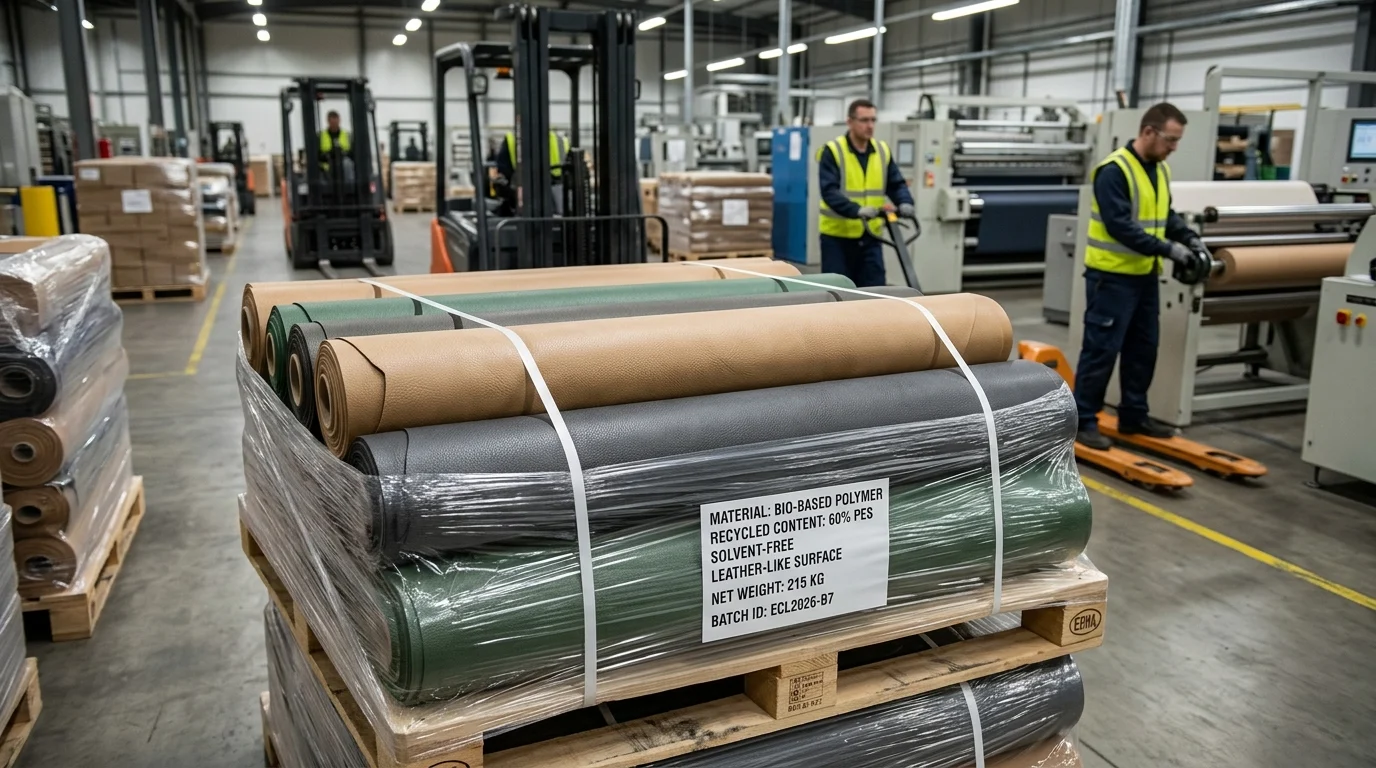
The definition of sustainable coated fabrics has matured significantly. In previous years, any material avoiding animal hides could be marketed as a vegan alternative, regardless of its petrochemical footprint. In 2026, the classification of eco friendly synthetic leather requires a demonstrable, audited reduction in fossil fuel dependency, water toxicity, and greenhouse gas emissions throughout its lifecycle.
Main material routes
The industry has consolidated around several primary material routes, each offering distinct advantages in terms of bio-content and scalability. The most commercially viable route is bio-based polyurethane (Bio-PU), where a portion of the polyols is derived from renewable biomass such as industrial corn, soy, or castor oil. Another expanding category utilizes agricultural waste—such as apple pomace, pineapple leaves, or grape skins—blended with a binder and applied to a textile backing.
Additionally, the substrate or backing fabric, which often accounts for up to 40% of the material’s total weight, has transitioned almost entirely to recycled polyethylene terephthalate (rPET) or organic cotton in premium applications. For highly experimental applications, mycelium (mushroom root networks) is being cultivated into leather-like sheets, though it remains a niche, low-volume option.
| Material Route | Bio-Content Potential | Current Scalability | Price Premium (vs Standard PU) |
|---|---|---|---|
| Waterborne Bio-PU | 30% – 45% | High | +30% to +50% |
| Agricultural/Fruit Waste | 40% – 60% | Medium | +100% to +200% |
| Mycelium (Mushroom) | 80% – 100% | Low | +300% to +500% |
| Recycled PET (rPET) Base | 100% (Substrate) | Very High | +10% to +20% |
Technical, environmental, and disclosure criteria
Qualification in 2026 relies on strict technical and environmental disclosure criteria. Buyers now require comprehensive Life Cycle Assessments (LCAs) compliant with ISO 14040 standards. To be legitimately classified as eco-friendly, a synthetic leather must typically achieve a minimum of 30% certified bio-based content, often verified through ASTM D6866 radiocarbon testing or USDA BioPreferred certification.
Environmental criteria also mandate the elimination of toxic solvents. The transition to waterborne PU (WPUD) or solvent-free PU is a non-negotiable standard for top-tier manufacturers, reducing Volatile Organic Compound (VOC) emissions by over 90% compared to traditional DMF-based coagulation processes. Furthermore, manufacturers must provide transparent trace data, proving that the agricultural inputs do not compete with food supplies or contribute to deforestation.
How eco friendly synthetic leather compares with conventional options
For procurement officers and product engineers, replacing legacy materials with sustainable alternatives requires strict adherence to performance specifications. The commercial viability of eco friendly synthetic leather hinges on its ability to match or exceed the mechanical properties of conventional PVC and solvent-based PU, while justifying its cost structure.
Key comparison points for buyers
The primary comparison points for buyers revolve around cost, yield, and aesthetic consistency. As of 2026, conventional solvent-based PU typically costs between $3.00 and $5.00 per linear yard, heavily subsidized by mature, highly optimized supply chains. In contrast, scalable eco-friendly options like waterborne Bio-PU range from $8.00 to $15.00 per yard, depending on the bio-content percentage and backing material.
Despite the higher upfront cost per yard, buyers must evaluate the total cost of ownership. Eco-friendly variants often yield higher cutting efficiencies due to fewer surface defects and eliminate the need for costly off-gassing procedures required by high-VOC conventional leathers. Furthermore, the aesthetic consistency—specifically the depth of grain embossing and color fastness—has reached parity with legacy materials, allowing brands to maintain premium product positioning.
Durability, hand feel, hydrolysis resistance, and VOC profile
Performance testing is where modern eco-friendly synthetic leathers prove their industrial readiness. Legacy materials frequently suffered from poor breathability and accelerated degradation in humid environments. Today’s advanced waterborne Bio-PUs exhibit superior hydrolysis resistance, often surviving 5 to 10 weeks in the rigorous Jungle Test (70°C at 95% relative humidity), easily meeting the 5-week minimum required by automotive OEMs.
| Performance Metric | Conventional Solvent PU | Eco-Friendly Waterborne Bio-PU | Automotive Target Spec |
|---|---|---|---|
| VOC Emissions | > 800 ppm | < 100 ppm | < 100 ppm |
| Hydrolysis Resistance (Jungle Test) | 3 – 5 weeks | 5 – 10 weeks | 5+ weeks |
| Tear Strength | > 35 N | > 30 N | > 30 N |
| Abrasion Resistance (Martindale) | 50,000 cycles | 50,000 – 100,000 cycles | 50,000+ cycles |
In terms of hand feel, bio-based synthetics can be engineered to mimic the buttery texture of full-grain calfskin or the stiff, durable finish of technical saffiano. Crucially, the VOC profile of waterborne eco-leathers remains below 100 parts per million (ppm), eliminating the chemical odor associated with conventional synthetics and ensuring compliance with stringent indoor air quality standards for vehicle cabins and residential furniture.
Supply chain, compliance, and production drivers
Scaling the integration of next-generation materials requires navigating a complex matrix of regulatory compliance, supply chain logistics, and manufacturing capabilities. As production volumes increase, the operational realities of sourcing eco friendly synthetic leather become the primary focus for global supply chain managers.
Regulations, restricted substances, and traceability
Regulatory frameworks govern the chemical inputs and traceability of synthetic textiles. Compliance with the EU’s REACH regulation and California’s Proposition 65 is standard baseline practice. However, in 2026, leading manufacturers must also adhere to the Zero Discharge of Hazardous Chemicals (ZDHC) Manufacturing Restricted Substances List (MRSL) Version 3.1, which strictly prohibits the intentional use of DMF, phthalates, and PFAS (per- and polyfluoroalkyl substances) in synthetic leather production.
Traceability is equally critical. Brands are utilizing digital product passports and blockchain-backed chain-of-custody platforms to verify the origin of both bio-based resins and rPET substrates. Physical tracers, such as isotopic signatures or luminescent pigments embedded in the polymer matrix, are increasingly deployed to prevent supply chain fraud and prove recycled content percentages to customs authorities.
Lead times, minimum order quantities, and coating capacity
The shift from solvent-based to waterborne and solvent-free coating lines has temporarily constrained global capacity, impacting lead times and minimums. Minimum Order Quantities (MOQs) for standard waterborne PU have stabilized at approximately 1,000 to 3,000 meters per colorway. However, highly specialized bio-materials, such as fruit-waste leathers requiring custom compounding, may demand MOQs exceeding 5,000 meters.
Lead times for eco-friendly synthetics currently average 45 to 60 days. This is slightly longer than the 30-day average for legacy PU, primarily due to the slower curing times required for waterborne resins and the limited availability of specialized drying ovens capable of handling high-throughput solvent-free production without compromising the material’s structural integrity.
Practical evaluation steps for brands and manufacturers
Brands and Original Equipment Manufacturers (OEMs) must adopt a rigorous, phased approach to evaluating new suppliers. The first step involves auditing Tier-2 chemical suppliers and Tier-3 raw material aggregators to ensure ISO 14067 (Carbon Footprint of Products) compliance.
Following paper audits, physical pilot testing on existing manufacturing lines is mandatory. Manufacturers should run 100-meter trial rolls through standard die-cutting, skiving, and stitching machinery. This ensures the eco-friendly material maintains a minimum tear strength of >30 N and does not cause excessive needle wear or require costly re-tooling of legacy assembly lines.
How brands and OEM buyers should decide

Transitioning to sustainable material architectures is a complex strategic maneuver that impacts every facet of a brand’s operations, from unit economics to marketing claims. Success requires a pragmatic approach to material selection and a clear understanding of long-term commercial trajectories.
Decision framework for material selection
A robust decision framework for material selection balances volume, product lifespan, and margin profiles. For high-wear, high-volume applications like automotive seating or commercial upholstery, buyers should prioritize waterborne Bio-PU with a 20% to 30% bio-content threshold. This configuration offers the optimal balance of necessary durability, regulatory compliance, and cost-efficiency.
Conversely, for high-margin, low-volume fashion accessories, brands can absorb the cost premiums of ultra-sustainable materials, such as 80% bio-based agricultural waste leathers or mycelium alternatives. Buyers must evaluate the sustainability return on investment—determining whether the consumer is willing to pay a premium for a specific eco-narrative, or if the transition is purely a defensive measure to meet baseline ESG mandates.
Commercial takeaway for investors and buyers
The commercial takeaway for investors and procurement leaders is that securing capacity for high-quality eco-friendly synthetic leather is a time-sensitive imperative. While current price premiums range from 30% to over 100%, industry forecasts project a 15% to 20% compression in these premiums by late 2028 as chemical suppliers scale waterborne resin production and achieve economies of scale.
Buyers who delay adoption risk facing severe bottlenecks in coating capacity as global mandates force competitors to pivot simultaneously. Early integration allows brands to lock in favorable supply agreements, refine their manufacturing processes, and establish verifiable environmental claims, ultimately positioning them to capture market share in a global economy that increasingly penalizes fossil-fuel dependency.
Key Takeaways
- The most important conclusions and rationale for eco friendly synthetic leather
- Specs, compliance, and risk checks worth validating before you commit
- Practical next steps and caveats readers can apply immediately
Frequently Asked Questions
What makes synthetic leather eco friendly in 2026?
It typically uses waterborne or bio-based PU, recycled backings like rPET, and audited reductions in solvents, fossil inputs, and emissions.
Why are brands switching from traditional PU and PVC now?
Regulations, carbon costs, and ESG pressure make solvent-based materials riskier and more expensive across apparel, footwear, and automotive supply chains.
Is eco friendly synthetic leather durable enough for footwear or car interiors?
Yes, many commercial grades are designed for abrasion, flexing, and surface performance, but buyers should request test data for the exact application.
Which eco friendly synthetic leather option is most scalable today?
Waterborne bio-based PU with rPET backing is currently the most scalable balance of sustainability, performance, and industrial supply volume.
Can hh-mf.com help source eco friendly synthetic leather for OEM projects?
Yes, HH-MF can support material selection and supply discussions for coated fabrics, especially when you need practical options for scalable manufacturing.