
Introduction
Feet can release a surprising amount of moisture in a day, and when that sweat stays trapped inside a shoe, comfort drops while friction, odor, and blister risk rise. Microfiber lining is designed to manage that problem by moving moisture away from the foot instead of simply soaking it up. This article explains how the material’s fine fiber structure supports wicking, evaporation, and a more stable in-shoe climate, and why that makes a practical difference in modern footwear. With that foundation, the body will look at the mechanics of moisture transport and the comfort benefits that follow.
How Microfiber Lining Keeps Feet Dry in Modern Footwear
The microclimate of modern footwear presents a complex thermal and moisture management challenge. The average human foot possesses approximately 250,000 sweat glands and can excrete up to 236 milliliters (about half a pint) of moisture per day during periods of high exertion. To prevent saturation, blister formation, and microbial proliferation, footwear architecture relies heavily on interior linings.
Microfiber lining has emerged as a primary solution for advanced moisture management in the footwear industry, shifting the paradigm from passive absorption to active moisture transport. By engineering the microscopic structure of the lining, manufacturers can manipulate fluid dynamics to maintain a stable, dry environment even under extreme physiological stress.
Why microfiber lining matters for moisture management and comfort
Managing the internal shoe microclimate requires materials that interface directly with the skin or sock layer to mitigate relative humidity. When internal humidity exceeds 70%, the coefficient of friction between the foot and the shoe increases dramatically, exponentially elevating the risk of dermal abrasion and blistering.
Microfiber lining addresses this challenge by rapidly drawing sweat away from the high-humidity zone adjacent to the foot. Instead of merely trapping the moisture, the material distributes it across a broader surface area within the shoe’s architecture, accelerating the evaporation rate and helping the foot maintain thermal equilibrium.
Which performance claims are technically realistic
While marketing materials often exaggerate the capabilities of synthetic linings, the technical reality is grounded in measurable fluid dynamics. A realistic performance baseline is that high-grade footwear microfiber can absorb between 200% and 300% of its own weight in water without suffering structural saturation or deformation.
However, claims that a lining completely “eliminates” sweat are technically false; the material merely acts as a moisture conduit. The efficiency of this conduit depends heavily on the ambient external humidity and the permeability of the footwear’s outer upper materials. If the outer shell is completely impermeable and lacks ventilation, even the most advanced microfiber lining will eventually reach its absorption threshold.
What Microfiber Lining Is and How It Moves Moisture
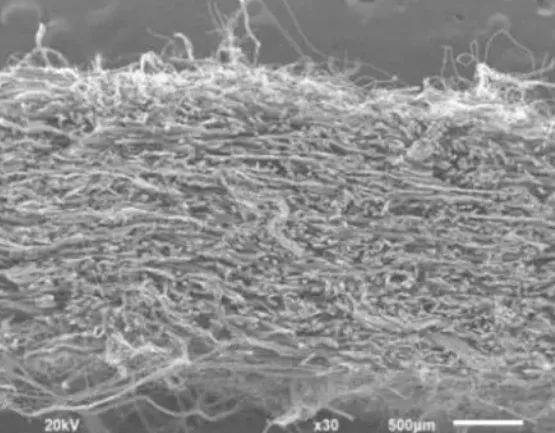
At a structural level, microfiber lining is an engineered synthetic textile, typically manufactured from a precise blend of polyester and polyamide (nylon) polymers. The fundamental mechanism of moisture movement relies on the physical geometry and density of these fibers rather than temporary chemical wicking treatments.
How fiber fineness, surface area, and capillary action work
By industry definition, a microfiber must have a linear density of less than 1.0 denier. In high-performance footwear linings, fibers are often extruded at 0.5 to 0.8 denier, making them significantly finer than a human hair. This extreme fineness exponentially increases the total surface area of the textile available for moisture interaction.
When moisture contacts the lining, capillary action engages instantly. The microscopic interstitial spaces between the densely packed fine fibers create a high-pressure gradient. This gradient acts as a mechanical pump, aggressively pulling liquid water upward and outward, away from the dermal layer and toward the outer strata of the shoe.
How different liner structures affect moisture transport
The overarching architecture of the lining dictates its wicking efficiency and structural stability. Non-woven, coagulated polyurethane (PU) microfiber is a dominant format in premium footwear. This specific structure mimics the random, three-dimensional collagen matrix of natural leather but maintains vastly tighter manufacturing tolerances.
Linings are typically specified between 0.6mm and 1.2mm in thickness, depending on the shoe’s design requirements. A 0.8mm coagulated microfiber provides an optimal baseline, offering a Moisture Vapor Transmission Rate (MVTR) high enough to prevent internal condensation while maintaining the tensile strength required to withstand the mechanical stress of walking and running.
How Microfiber Lining Compares with Other Footwear Linings
Selecting a lining material requires a rigorous comparative analysis of technical specifications, lifecycle costs, and physical performance metrics. Microfiber operates in a highly competitive matrix alongside traditional full-grain leather, pigskin, and standard polyester mesh, requiring procurement teams to weigh specific performance variables.
Which criteria matter most in a comparison table
When evaluating lining materials, footwear engineers prioritize moisture vapor transmission, absorption capacity, durability under friction, and raw material cost. The following table illustrates baseline metrics across standard industry materials:
| Material Type | Typical MVTR (mg/cm²/h) | Absorption Capacity (%) | Dry Abrasion Resistance (Martindale Cycles) | Average Cost ($/linear yard) |
|---|---|---|---|---|
| Premium Microfiber | 25 – 35 | 200% – 300% | > 50,000 | $4.50 – $8.00 |
| Full-Grain Calf Leather | 15 – 20 | 150% – 200% | 30,000 – 40,000 | $10.00 – $18.00 |
| Pigskin Lining | 10 – 15 | 100% – 150% | 20,000 – 25,000 | $3.50 – $6.00 |
| Standard Poly Mesh | 40 – 50 | < 50% (Dries fast, holds little) | 15,000 – 25,000 | $1.50 – $3.00 |
This standardization highlights microfiber’s position as a high-durability, moderate-cost alternative. It consistently outperforms traditional leathers in active moisture handling while offering vastly superior abrasion resistance compared to standard lightweight mesh.
What trade-offs buyers should evaluate
Buyers must navigate specific trade-offs when transitioning a product line to microfiber. While it offers superior batch-to-batch consistency and virtually zero cutting waste compared to natural hides (which typically yield only 60% to 70% usable material due to scarring and edge irregularities), microfiber can exhibit slightly lower thermal retention in sub-zero environments.
Additionally, while the raw material cost of $4.50 to $8.00 per linear yard is economically attractive, engineers must factor in the secondary costs of compatible construction chemicals. Using the wrong adhesives or backing materials to save money will inevitably compromise the synthetic fiber’s capillary networks, negating the material’s primary moisture-wicking advantage.
How Design and Quality Control Affect Lining Performance
The intrinsic moisture-wicking properties of microfiber are highly vulnerable to poor footwear architecture and substandard manufacturing processes. A high-performance lining can be rendered functionally inert if integrated incorrectly during the factory assembly phase.
How footwear construction influences moisture handling
The application of adhesives between the outer upper material and the microfiber lining is the most critical variable in footwear construction. Continuous film applications of cheap, solvent-based adhesives can block up to 70% of the lining’s interstitial pores, effectively destroying its capillary action.
To preserve breathability and moisture transport, assembly facilities must utilize dot-coating techniques or breathable water-based polyurethane adhesives. These application methods ensure that at least 50% of the lining’s surface area remains unobstructed, allowing moisture vapor to pass through the adhesive layer into the shoe’s outer shell.
Which test methods and specifications matter
Rigorous quality control relies on standardized testing to verify moisture management capabilities before mass production begins. Under the SATRA TM172 standard for water vapor permeability, an effective footwear microfiber lining must achieve a minimum transmission rate of 20 mg/cm²/h.
Furthermore, because internal moisture significantly increases textile friction, wet abrasion testing via SATRA TM31 is mandatory for performance validation. High-grade linings must withstand a minimum of 25,600 cycles in wet conditions without fiber pilling, structural degradation, or color bleeding to pass standard athletic footwear specifications.
What common failure points to watch for
Common manufacturing failure points often stem from improper thermal management during the lamination phase. Exposing the microfiber to temperatures exceeding 130°C can cause the fine polyamide fibers to partially melt, permanently fusing the microscopic capillary channels closed.
Poorly calibrated lamination machinery accounts for a typical defect rate of 3% to 5% in lower-tier manufacturing facilities. This specific failure mode results in shoes that look structurally perfect on the retail shelf but suffer from severe internal condensation, clamminess, and accelerated delamination under actual field conditions.
When to Choose Microfiber Lining
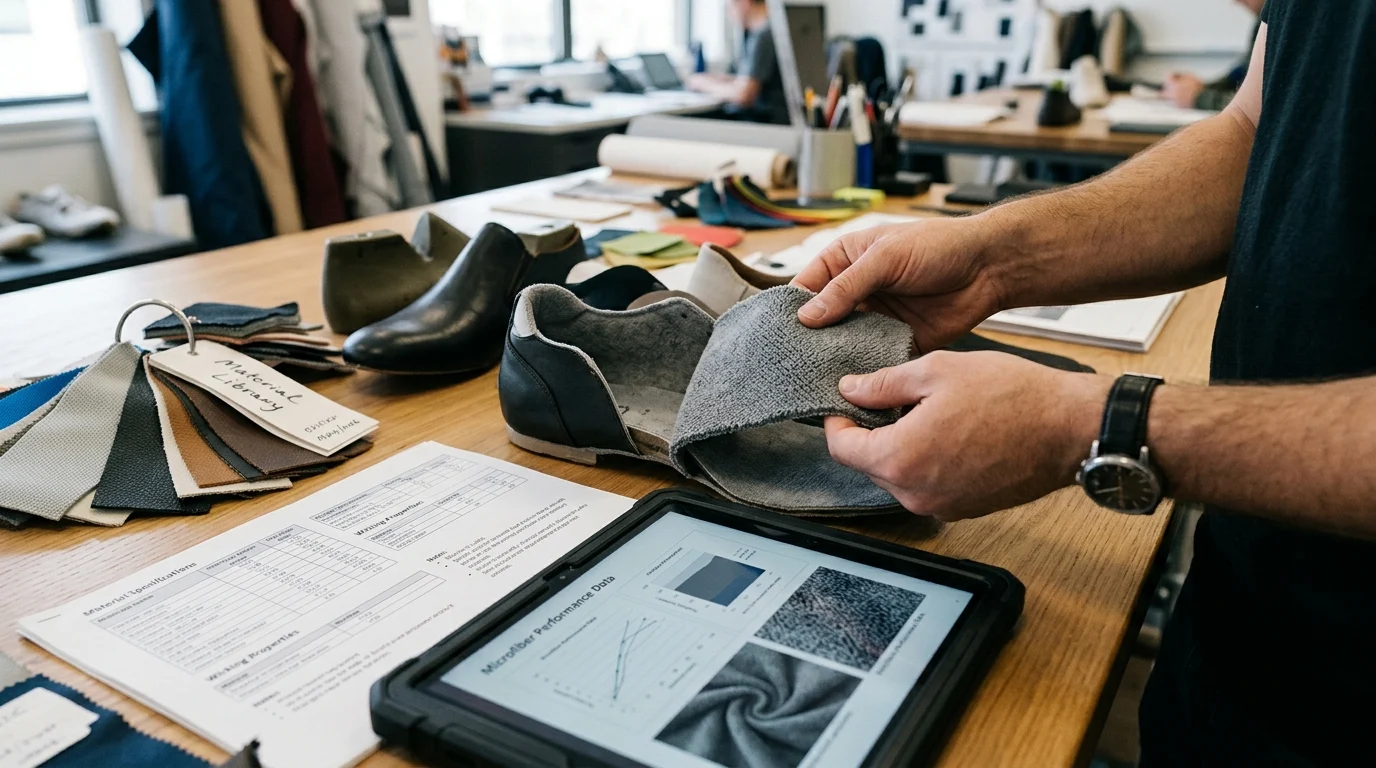
The integration of microfiber linings is a strategic decision that aligns material science with the specific environmental and mechanical demands of the target footwear category. It is not a universal substitute for all linings, but rather a specialized tool engineered for high-demand applications.
When microfiber lining offers a clear product advantage
Microfiber lining provides a definitive product advantage in athletic, tactical, and waterproof-breathable footwear. In boots utilizing expanded polytetrafluoroethylene (ePTFE) membranes (such as Gore-Tex), the inner lining must transport liquid sweat to the membrane surface instantly for the system to function.
Microfiber’s rapid wicking capability prevents the “clammy” sensation often associated with waterproof boots. This makes it indispensable for high-exertion applications where internal moisture buildup leads to rapid heat loss in cold environments or severe friction blistering in hot, humid climates.
Which decision criteria should guide material selection
Material selection should be guided by a matrix of end-use requirements, production scale, and target performance metrics. Minimum Order Quantities (MOQs) for custom-dyed microfiber linings typically range from 500 to 1,000 linear meters, making the material highly accessible for mid-to-large production runs.
| Footwear Category | Recommended Lining Thickness | Primary Performance Focus | Target MVTR (mg/cm²/h) |
|---|---|---|---|
| High-Output Athletic | 0.6mm – 0.8mm | Rapid wicking, low weight | > 35 |
| Tactical / Workwear | 1.0mm – 1.2mm | High wet abrasion resistance | 20 – 25 |
| Waterproof Outdoor | 0.8mm – 1.0mm | Membrane compatibility | 25 – 30 |
| Casual / Lifestyle | 0.6mm – 0.8mm | Tactile comfort, aesthetics | 15 – 20 |
Ultimately, selecting a microfiber lining requires aligning the physical geometry of the fibers with the thermodynamic realities of the shoe’s intended use. When specified correctly and assembled with permeable adhesives, microfiber represents one of the most efficient, durable mechanisms for maintaining a dry, stable microclimate in modern footwear design.
Key Takeaways
- The most important conclusions and rationale for Microfiber Lining
- Specs, compliance, and risk checks worth validating before you commit
- Practical next steps and caveats readers can apply immediately
Frequently Asked Questions
How does microfiber lining keep feet drier than standard linings?
Its ultra-fine fibers create capillary channels that pull sweat away from the foot and spread it for faster evaporation, reducing dampness and friction inside the shoe.
Can microfiber lining completely stop foot sweat?
No. It manages moisture by moving sweat away from the skin, but overall dryness also depends on shoe ventilation, upper permeability, and activity level.
What thickness works best for footwear microfiber lining?
Around 0.8mm is a practical baseline for many shoes, balancing moisture transfer, comfort, and durability under repeated walking or running stress.
Why do B2B footwear buyers choose microfiber lining from HAOHAO?
HAOHAO offers scalable supply, technical development support, and consistent quality control, helping brands move from material selection to mass production reliably.
Which shoe types benefit most from microfiber lining?
Sports shoes, casual footwear, work shoes, and boots benefit most, especially when the design needs better moisture management, abrasion resistance, and stable lining performance.