
Introduction
For car interiors, durability is not just about resisting scratches on day one; it also means holding shape, color, and surface feel through years of heat, UV exposure, spills, and daily abrasion. That is why the comparison between microfiber leather and PVC leather matters beyond price alone. This article examines how microfiber leather is built, how its structure differs from PVC, and what those differences mean for wear resistance, flexibility, aging, and maintenance in real automotive use. By the end, readers will have a clearer basis for judging whether microfiber leather offers the longer-lasting choice for seats, panels, and other high-contact interior surfaces.
Why microfiber leather vs PVC leather matters for automotive
Automotive interior engineering demands materials that balance cost, aesthetic appeal, and long-term resilience. As the industry shifts toward vegan and sustainable interiors, the debate between microfiber leather and PVC leather has intensified. OEMs typically engineer interior materials to withstand 10 to 15 years of harsh environmental exposure, equating to roughly 150,000 miles of use.
Choosing the right synthetic substrate directly impacts not only the perceived luxury of the cabin but also the warranty liability of the manufacturer. Understanding the fundamental durability differences between these two dominant synthetic leathers is essential for automotive procurement teams and interior trim engineers.
How OEMs, tier suppliers, and aftermarket brands define each material
Original equipment manufacturers (OEMs), Tier 1 suppliers, and aftermarket trimmers categorize these synthetic leathers based on their structural composition. PVC (polyvinyl chloride) leather relies on a traditional woven or knitted fabric backing coated with a plasticized PVC layer. It is a legacy material known for its high yield and low production costs.
Conversely, microfiber leather utilizes a non-woven matrix of ultra-fine fibers—typically polyamide—impregnated with a high-grade polyurethane (PU) resin. This highly engineered structure closely mimics the natural collagen bundle architecture found in genuine animal hide, classifying it as the highest tier of synthetic leather available to automotive brands.
Which operating conditions expose the biggest performance gaps
The operational environment of a vehicle cabin is exceptionally severe. Surface temperatures on dashboards and seats can fluctuate dramatically, ranging from -40°C in winter climates to over 85°C when a vehicle is parked in direct summer sunlight.
Under these thermal extremes, PVC leather is prone to rapid degradation. High heat accelerates plasticizer migration, while freezing temperatures cause the PVC coating to become rigid and brittle, heavily compromising its flexural endurance. Microfiber leather demonstrates superior thermal stability, maintaining its structural integrity and pliability across this broad temperature spectrum without off-gassing volatile organic compounds (VOCs) at the same rate as traditional PVC.
What microfiber leather and PVC leather are in automotive interiors
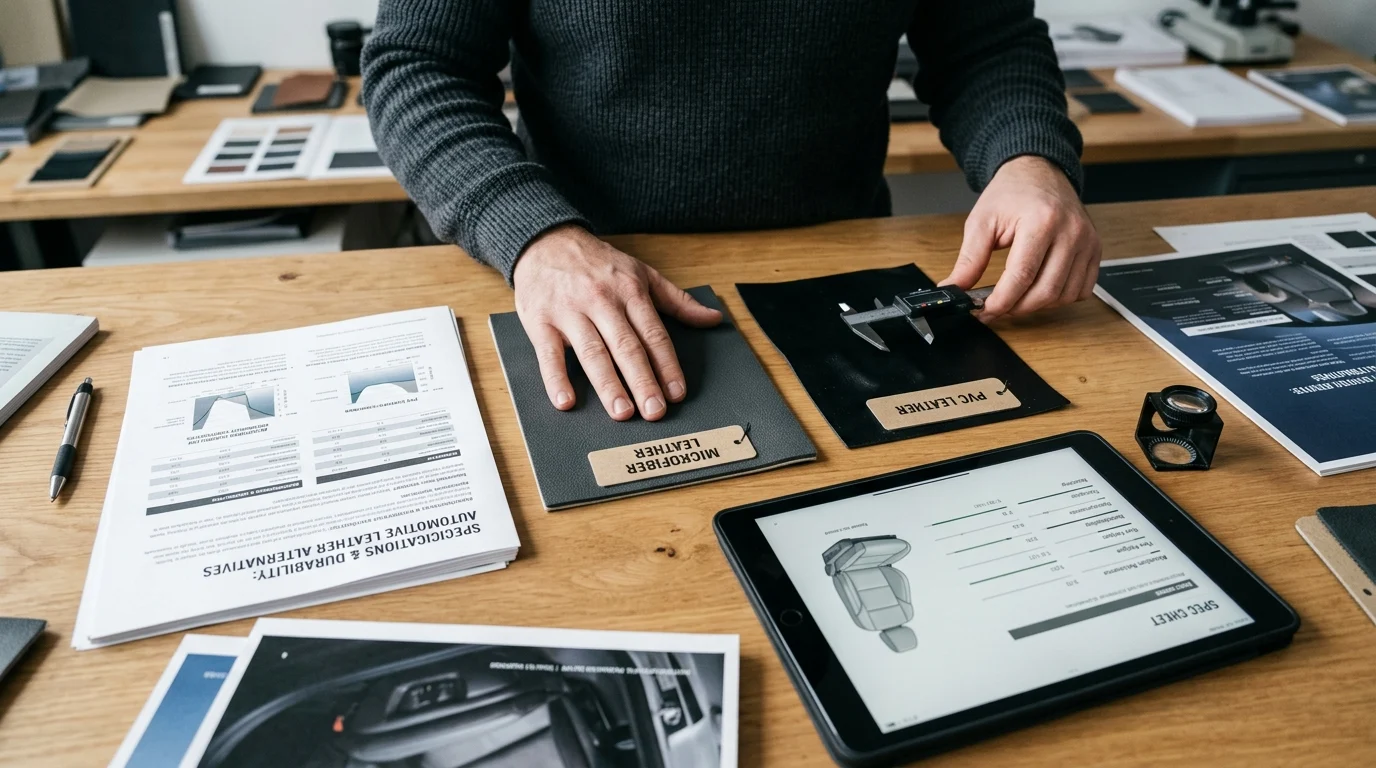
Understanding the fundamental architecture of these materials is crucial for predicting their longevity in automotive applications. The structural differences dictate not only the tactile experience but also the mechanical limits of the upholstery.
Microfiber leather fibers typically measure less than 0.01 denier, allowing for an incredibly dense, tightly interlocked matrix that conventional synthetic backings cannot achieve. This microscopic architecture is the primary driver behind the material’s premium performance metrics.
How microfiber structure influences abrasion resistance and comfort
The “sea-island” fiber spinning technique used to produce microfiber leather creates a three-dimensional non-woven network. This architecture grants the material exceptionally high tensile and tear strength, often exceeding 120 N in standardized tear resistance tests.
Furthermore, the micro-porous structure of the polyurethane resin facilitates moisture vapor transmission. This inherent breathability significantly enhances passenger comfort during prolonged seating by dissipating body heat and sweat—a functional characteristic largely absent in conventional synthetic alternatives that utilize solid, impermeable coatings.
How PVC formulation affects plasticizer migration and climate durability
PVC leather relies heavily on chemical plasticizers, frequently phthalates, to achieve flexibility, as raw polyvinyl chloride is an inherently rigid polymer. Over time, and under continuous exposure to UV radiation and thermal cycling, these plasticizers migrate to the surface and evaporate.
This chemical exudation results in the notorious “fogging” effect on interior glass and leaves the PVC matrix depleted. Consequently, the material loses its elasticity, becoming highly susceptible to micro-cracking and eventual structural failure, particularly in sub-zero climates where the glass transition temperature of the depleted polymer is easily reached.
How microfiber leather compares with PVC leather in automotive use
When evaluating microfiber leather versus PVC leather for automotive use, engineers rely on standardized testing to quantify durability, tactile feel, and aesthetic retention. The performance delta between the two materials is stark, particularly in high-stress applications.
| Property | Microfiber Leather | PVC Leather |
|---|---|---|
| Base Structure | Polyamide sea-island microfibers | Woven/knitted polyester or cotton |
| Coating | Polyurethane (PU) resin | Polyvinyl Chloride with plasticizers |
| Breathability | High (micro-porous) | Very Low (impermeable) |
| Cold Weather Flex | Excellent (remains supple) | Poor (stiffens, prone to cracking) |
Which comparison points matter most for buyers
Buyers prioritize metrics that directly correlate with warranty claims and customer satisfaction. Key comparison points include Taber abrasion resistance, flexural endurance, tear strength, and hydrolysis resistance.
While PVC can be engineered to resist surface scratches, it falls short in dynamic flex testing. Microfiber leather consistently outperforms PVC in maintaining its grain structure and colorfastness after tens of thousands of entry and exit friction cycles.
How seat surfaces, door panels, and steering wraps differ by material
Material allocation within the cabin depends heavily on the specific mechanical demands of the component. Seat bolsters and cushions experience high friction, dynamic loading, and moisture transfer, making the breathable and highly abrasion-resistant microfiber leather the superior specification.
Conversely, lower door panels and seatbacks endure minimal direct contact, allowing manufacturers to deploy PVC leather as a cost-reduction strategy. Steering wheel wraps demand exceptional resistance to human sebum (skin oils) and continuous abrasive grip; here, premium microfiber leather prevents the rapid degradation and peeling often seen with lower-tier synthetics.
Which failure modes to track, including peeling and delamination
Tracking specific failure modes is essential for quality assurance and lifecycle management. PVC leather primarily fails through plasticizer loss, resulting in irreversible stiffening, surface cracking, and color fading under sustained UV load.
Microfiber leather, while highly durable, can be susceptible to hydrolysis—the chemical breakdown of the polyurethane polymer chain in the presence of high humidity and heat. However, modern automotive-grade microfiber utilizes advanced polycarbonate-based PU resins engineered to withstand over 840 hours (5 weeks) of accelerated hydrolysis testing at 70°C and 95% relative humidity without exhibiting peeling or delamination.
Which sourcing, compliance, and cost factors affect material selection
Procurement decisions in automotive manufacturing must balance raw material performance against stringent global compliance standards and unit economics.
The cost disparity is significant: automotive-grade microfiber leather typically ranges from $12 to $25 per linear meter, whereas PVC leather commands a much lower price point of $3 to $8 per linear meter. Navigating this gap requires a deep understanding of manufacturing variables and total lifecycle costs.
How backing fabric, coating quality, and embossing influence performance
The physical characteristics of the backing fabric and the precision of the coating process dictate the final yield and performance. Microfiber leather generally features a total thickness between 1.0 mm and 1.4 mm for automotive seating applications, providing a plush, substantial hand-feel.
The quality of the embossing process, which imparts the leather grain, also affects durability. Overly deep embossing on thin PVC coatings creates stress concentrations that serve as initiation points for flex-cracking, whereas the dense microfiber base distributes embossing stress evenly across its three-dimensional matrix.
Which automotive compliance and qualification benchmarks to check
Automotive materials must pass rigorous regulatory and OEM-specific qualification benchmarks before they can be specified for mass production.
| Compliance Standard | Testing Focus | Microfiber Performance | PVC Performance |
|---|---|---|---|
| FMVSS 302 | Flammability | Passes with FR additives | Passes inherently (chlorine base) |
| REACH / RoHS | Restricted Substances | High compliance (low VOC) | Phthalate restrictions require costly reformulations |
| ISO 105-B06 | UV / Lightfastness | Excellent color retention | Susceptible to fading and chalking |
How to evaluate total cost of ownership
Evaluating the total cost of ownership (TCO) requires looking beyond the per-meter procurement cost. Microfiber leather often yields a lower TCO in premium applications due to drastically reduced warranty claims for premature wear, peeling, and cracking.
Furthermore, microfiber leather is highly valued for its mass efficiency. In the electric vehicle (EV) sector, shedding several kilograms from the interior assembly directly translates to extended battery range, adding a hidden performance value that easily offsets the higher initial material cost.
How buyers should choose between microfiber leather and PVC leather
The choice between microfiber leather and PVC leather ultimately requires a strategic alignment of material capabilities with vehicle positioning. Because interior materials account for a substantial portion of perceived vehicle quality, buyers must weigh upfront savings against long-term durability.
Specifying a material with a flexural endurance of over 100,000 cycles—typical of automotive microfiber—versus the 30,000 cycles typical of standard PVC profoundly impacts the vehicle’s lifecycle aesthetic and resale value.
What selection process helps match material to application
A rigorous selection process begins with defining the component’s functional requirements, including expected friction cycles, UV exposure angles, and necessary breathability.
Procurement teams typically utilize a decision matrix that scores materials on cost, weight, tactile luxury, and environmental compliance. By mapping these scores against the target demographic and price point of the vehicle platform, OEMs can accurately specify the right synthetic leather for specific cabin zones, optimizing both budget and performance.
When microfiber leather is the better durability choice
Microfiber leather is the definitive choice for high-durability requirements and premium vehicle tiers. It excels in primary touchpoints—such as seating surfaces, armrests, and steering wheels—where passenger comfort and long-term abrasion resistance are non-negotiable.
Additionally, its superior strength-to-weight ratio makes it highly attractive for luxury electric vehicles. Because microfiber leather can be up to 30% lighter than PVC leather of comparable thickness, engineers can aggressively reduce cabin mass without compromising the opulent, genuine-leather feel of the interior.
When PVC leather is the better value choice
PVC leather remains a highly viable, value-driven choice for economy vehicle platforms, heavy-duty commercial trucks, and rental fleets.
It is particularly suited for low-impact interior zones, such as door card inserts, headliners, and rear seatbacks, where the risk of abrasion is minimal. When upfront cost reduction is the primary driver and the component is not subjected to continuous dynamic flexing or extreme tactile scrutiny, modern automotive-grade PVC provides an acceptable balance of functional coverage and economic efficiency.
Key Takeaways
- The most important conclusions and rationale for Microfiber leather
- Specs, compliance, and risk checks worth validating before you commit
- Practical next steps and caveats readers can apply immediately
Frequently Asked Questions
Which lasts longer in car interiors: microfiber leather or PVC leather?
Microfiber leather usually lasts longer. Its non-woven microfiber and PU structure resists cracking, abrasion, and temperature swings better than PVC, which can harden as plasticizers migrate over time.
Why does PVC leather crack faster in vehicles?
PVC depends on plasticizers for flexibility. Heat, UV, and cold can drive those additives out, causing stiffness, surface fogging, and eventual cracking, especially on seats and trim exposed to sunlight.
Is microfiber leather better for hot and cold climates?
Yes. Microfiber leather stays more stable from low to high cabin temperatures, helping it remain flexible in winter and less prone to heat-related degradation in summer than PVC.
Does microfiber leather feel more comfortable than PVC for car seats?
Usually yes. Microfiber leather has a micro-porous structure that improves breathability and reduces sticky surface feel, making long drives more comfortable than typical impermeable PVC upholstery.
Can HAOHAO support automotive microfiber leather projects at scale?
Yes. HAOHAO offers automotive synthetic leather manufacturing with 3 specialized factories, 20+ years of experience, and scalable R&D-to-production support for OEM, Tier, and aftermarket programs.